

































A Better Max
 Lately my Google Alert emails have become polluted with other Max
Barrys. I guess I knew it had to happen. I couldn’t have the web
to myself forever. But all of a sudden there are
three of us. The first guy to show up was okay.
He
writes about NFL. I gather that’s some kind of football. Not
the
good kind. But still. I was
just glad he was doing something. I didn’t want some whiny,
self-obsessed blogger Max Barry confusing everybody. I have that
base covered.
Lately my Google Alert emails have become polluted with other Max
Barrys. I guess I knew it had to happen. I couldn’t have the web
to myself forever. But all of a sudden there are
three of us. The first guy to show up was okay.
He
writes about NFL. I gather that’s some kind of football. Not
the
good kind. But still. I was
just glad he was doing something. I didn’t want some whiny,
self-obsessed blogger Max Barry confusing everybody. I have that
base covered.

But now this third guy. I’ve been worried about the wrong thing. Because this Max Barry, he’s better-looking than me. He models. He’s younger. More hair. I guess that goes without saying. But really: tons of hair. He cooks. Plays tennis semi-professionally. Works as a personal trainer. Posts workouts-of-the-day to his website. Workout-of-the-days? Whatever. He’s a god, is my point. A toned, buffed, let-me-whip-you-up-a-filet-mignon god. He makes me look like crap.
At this point I haven’t decided whether to break into his house in the middle of the night and stab him or become fast friends and use him as my body double for TV interviews. That’s a decision for the new year.
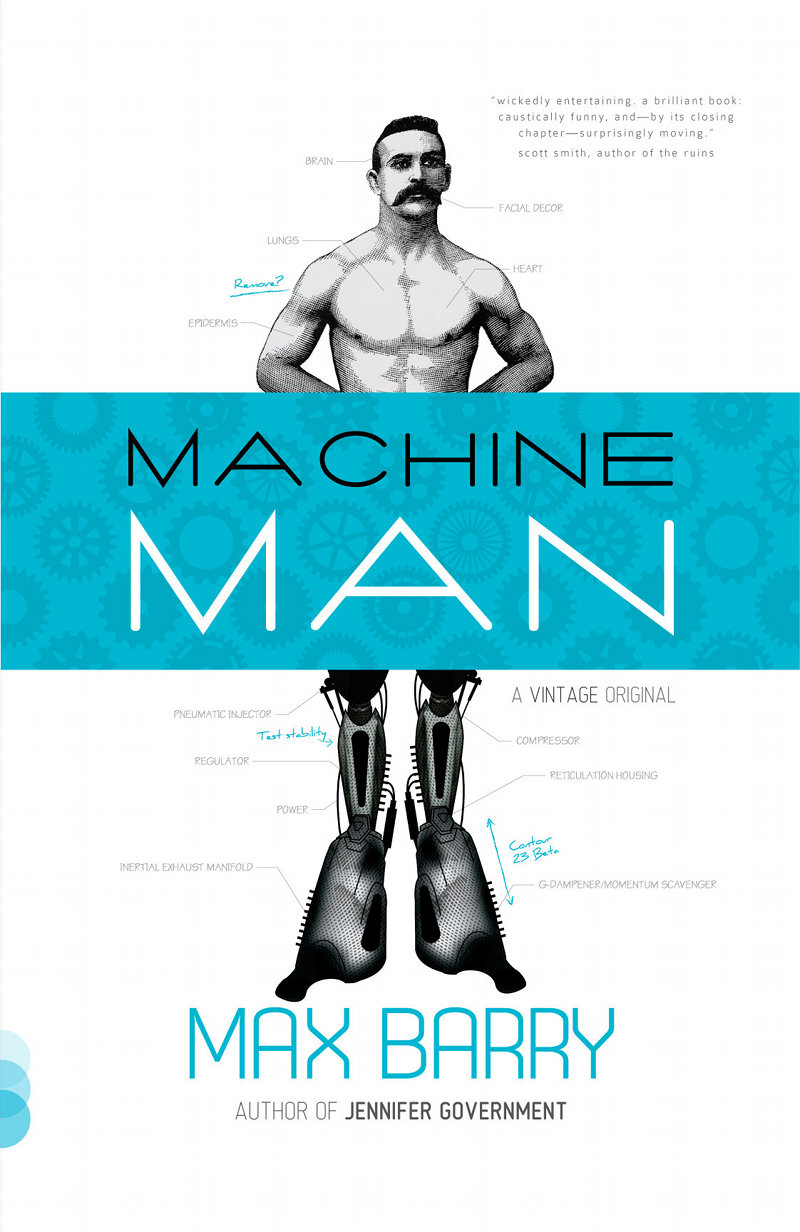
Speaking of which! That’s it from me for 2009. Thank you so much to everyone who cared enough to follow what I’m doing this year. Double thanks to everyone who made this the year of Machine Man. Triple—wait, this is getting ridiculous. But thank you, thank you to those who emailed me feedback on the serial, because that is incredibly helpful as I turn this thing into a novel.
I hope your year was a good one, and your next is better. And may I leave you with this: my daughter Finlay’s first ever appearance on stage, at her four-year-old ballet concert. They are dressed as kangaroos, if you’re wondering. This was one of the most terrifyingly beautiful moments of my life. I’m not talking about the dancing. I’m talking about what happened next.
It’s Not Me, It’s You

I’ve written more bad fiction than you’ve read. I’m serious. I’ve done a hundred or so drafts of nine or ten manuscripts, and let’s not even start on the shorter stuff. Read one of my books? Think it could have been better? Well that’s what they published. That was polished.
After a decade of wrangling paragraphs for a living, I have decided: it’s always the book’s fault. When your scene won’t quite come together, your novel idea won’t stay interesting, your main character refuses to fill out: it’s not because you lack talent. It’s because your idea is stupid. You’re trying to push shit uphill. And you may be a good shit-pusher, with a range of clever and effective shit-pushing techniques, but still: it’s going to be hard, frustrating, and ultimately you’ll discover you still don’t have your shit together.
I used to believe that an author needed an iron will. Discipline, to forge through the bitter dark and emerge clutching a tattered, tear-stained first draft. Now I think that’s a good way to lose nine months on a bad idea. Because if you have any skill as a word-slinger, you can make a bad idea sound okay. Not brilliant. But mildly interesting, at least for a while. Keep pushing that shit, though, and depression sets in. That’s when you think: I’m not good enough. Or: If I were more disciplined I’d finish this. Or: I can’t write.
Sure you can. You just can’t write this and stay interested, because it’s a stupid idea. It’s predictable. It’s been done. It had one intriguing aspect and you tapped that out within the first three pages. You don’t want to write this because your body is bone-bored of it.
A good idea excites you. It makes each day of writing a little joy. A good idea, when you peel it, has more good ideas inside. It makes you feel clever. It doesn’t need to be articulated. It might sound silly when you try to explain it. (Don’t try to explain it.) But you know there’s something there. It pulls you to the keyboard. It spills words from your fingertips. Some days, you lose your grip; you wander from the path and lose sight of where you were. But a good idea calls out to you.
A while ago I had The Block. The way I got out of it was to write a page of something new every day. The first week, I flushed out a lot of ideas that had been humming around the back of my brain, promising me they were brilliant. They weren’t. I captured them one page at a time and set them aside. The second week I wrote two things that were kind of interesting. Not very interesting. But not abominations, either. It was possible to imagine that in some alternate universe of very low standards, they could become novels. Not popular novels. But still.
The third week, I wrote something interesting. And I discovered I could write. That the reason I’d been stuck wasn’t because I’d forgotten where the keys were. It was because the story I was trying to make work sucked.
So that’s my advice to anyone mired in a story. Don’t blame yourself. You’re great. It’s just that stupid idea.
That Screaming Sound In Your Ears is Feedback

 So I finished Machine Man. And I want to stay all cool and authory
about it, but honestly, I feel a little heartbroken. I think because when I tap out
THE END on a regular novel first draft, it means I finally have something I
can show people. But Machine Man wasn’t a regular first draft: it
was an experience, me posting one page at a time and checking the next morning
to see what people thought. That was freaking wonderful—terrifyingly wonderful—and now it’s over, I already miss it.
So I finished Machine Man. And I want to stay all cool and authory
about it, but honestly, I feel a little heartbroken. I think because when I tap out
THE END on a regular novel first draft, it means I finally have something I
can show people. But Machine Man wasn’t a regular first draft: it
was an experience, me posting one page at a time and checking the next morning
to see what people thought. That was freaking wonderful—terrifyingly wonderful—and now it’s over, I already miss it.
I think I will need to do this again. This, or something like it.
But my next step is turning the serial into a novel. Every first draft can be better; my first drafts can be a lot better. If you read this serial—even if you only read some of it—I would love to know what you thought. I usually distribute my first drafts to ten or twelve early readers. This time there are 600 of you, another three or four thousand in the free feeds. As a feedback junkie, this makes me trembly and excited.
If you’ve got an opinion, please let me hear it. I want nothing more than to make my stories as strong as they can be, and I need to figure out how this book reads to someone who hasn’t written it. So please help me: post a comment. Or, if you’d prefer to keep it private, email me.
I tell all my early readers: I’m after what you felt. Please don’t think you need to be a literary critic. Don’t try to imagine what other people might like. Above all, don’t hold back because you can’t think how to justify what the book made you feel. Figuring out why you had a particular reaction and what to do about it, that’s my job. I can do that. What I can’t do is read my own book for the first time. The closest I can get is hearing you describe how you felt when you read it.
Please do tell me what you liked and what you didn’t. I’m looking for flaws, but part of figuring out what to improve is understanding where its heart is. Also, I tend to assume that anything an early reader doesn’t mention she didn’t care terribly much about, so it’s a candidate for the ax. If you stopped reading at some point, please tell me where. If you’re partway through, please share your thoughts so far. If you don’t know what the hell I’m talking about with feelings versus literary criticism and all that, please comment anyway. One-sentence thoughts are fine. I can’t get too much feedback. Please. Tell me.
A Business Fable
Once upon a time a boy went to business school. The boy was not sure he wanted to go into business, because what he most loved was writing stories about aliens and monsters and girls who did not love him back. But he knew he could not hope to earn a living from such stories, so business school it was.
The boy learned many interesting things, until he began to think perhaps business was for him after all. One day, he attended a class in which students were divided into groups and asked by the lecturer to solve the following puzzle:
“A man buys a horse for $400. He feeds it, trains it, and sells it to a racetrack manager for $500. However, soon he regrets his decision, and asks the racetrack manager if he can have the horse back. The racetrack manager, being a good capitalist, asks for $700. The man objects, seeing no reason why the horse should be worth so much more than the day before, but eventually he relents and accepts the loss. Some years later, he finally sells the horse to neighbor for $800. Question: What is his total profit or loss?”
The boy’s group began to discuss this puzzle. The boy thought the solution was fairly obvious: the man bought and sold the horse twice, making $100 profit each time. However, his teammates were seduced by the puzzle’s suggestion of a loss, and insisted this be accounted for. They thought the man broke even.
The boy tried to explain his reasoning a different way. He added up the man’s outlays and revenues, showing the difference was $200. The group agreed, but insisted this was then canceled out by the loss. The boy tried again. “Imagine it’s not the same horse,” he said. “The man buys and sells one horse, then buys and sells a second horse.” The debate became heated. There was no second horse, the group insisted. There was one horse, and the man broke even.
After a few minutes, the lecturer halted the exercise and asked each group for its verdict. Only unanimous decisions would be accepted. Every other group in the class declared their belief that the man broke even. The boy’s group hissed at him to bow to the majority opinion, but he could not bring himself to do it. They informed the lecturer that they could not agree.
The answer, said the lecturer, was that the man made $200 profit. However, the exercise was not about that. It was designed to test teamwork. He had observed most groups working effectively: establishing leadership roles, managing divergent opinion, and finding common ground to reach a shared solution. The boy’s team, however, was a textbook example of failure: it had allowed a disruptive element to block them from consensus. It was then that the boy decided business was probably not for him.
Hollywood Wants a Piece of Charlie
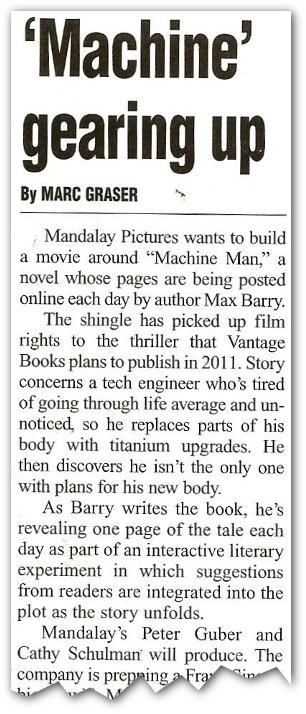 You
were in Hollywood trade Bible
Variety. No,
really. True, you weren’t the main focus. The main focus was
OH BY THE WAY
THEY’RE MAKING A MACHINE MAN MOVIE.
You
were in Hollywood trade Bible
Variety. No,
really. True, you weren’t the main focus. The main focus was
OH BY THE WAY
THEY’RE MAKING A MACHINE MAN MOVIE.
Well, when I say “making,” I mean “it’s in development.” And as we have learned, sometimes painfully, movies in development often do not make it out of development, at least not in our lifetimes. But still! This is a pretty amazing thing for a not-quite-finished experiment in fiction.
“They” in this case is Mandalay Pictures, who do actually get stuff made, and who I think get this concept particularly well. I’m not saying they’re self-mutilators. I have no proof of that. Let’s just say that if you were, I think they’d be sympathetic.
So Marc Graser of Variety reported this, and look what he said!
…suggestions from readers are integrated into the plot as the story unfolds.
I’m not sure I want that in print. That seems like the kind of thing that could lead to lawsuits. But, well, it’s true: you guys post comments, I read them, and that affects what I write the next day. So there you go. We have a film deal.
I have to mention (again) my Machine Man muse/tormentor M.I. Minter, the guy who essentially provoked me into doing this, because his response to this latest development was:
It’s amazing the fantastic things that happen when you regularly produce work.
I’m starting to suspect that M.I. Minter will make one hell of a Daddy one day. He has a knack of delivering delicious, crunchy praise with a chewy, you-can-do-even-better center.
Machine Man Word Cloud
I discovered a word cloud generator, so naturally enough I pasted
Machine Man into it.
It looks like this:
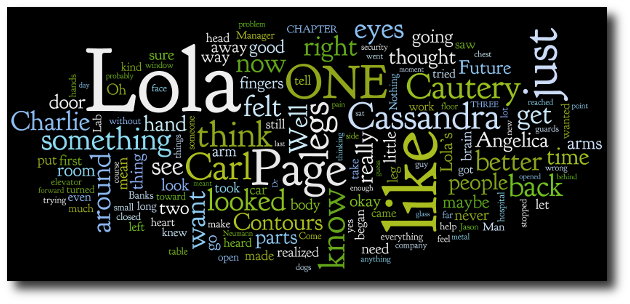
Image courtesy wordle.net
That’s pretty awesome. I love the big Lola. I’m disappointed “just” is so big, though. I have to stop using that. Possibly I am overdoing the similes, too, with a “like” of those dimensions. But the scattering of body parts is nice.
Big Brother Is Actually Not Watching You At All

 Nine
girls were trapped in a big house in Turkey, their every move filmed
for the titalation of their captors. Not recently. This was about a month ago. I’m
only mentioning it now because a month ago
my brain wasn’t working. Back then,
I just thought, “That… irony… blog.” That’s as far as I got. But I’m feeling better now,
thanks for asking.
Nine
girls were trapped in a big house in Turkey, their every move filmed
for the titalation of their captors. Not recently. This was about a month ago. I’m
only mentioning it now because a month ago
my brain wasn’t working. Back then,
I just thought, “That… irony… blog.” That’s as far as I got. But I’m feeling better now,
thanks for asking.
So the interesting part is that the girls thought they were on Big Brother. According to reports:
…the women were not abused or harassed sexually, but were told to fight each other, to wear bikinis, and to dance by the villa’s pool.
Upon discovering this was not for a national TV audience but just a couple of horny old men who owned the house (I’m guessing), the girls reacted badly. Apparently they demanded to be released. But they’d signed contracts, promising to stay for at least two months, and the contracts had some pretty serious penalty clauses: tens of thousands of dollars if the girls left early. I guess you call that a pay or play deal.
The girls took the position they’d been duped, so they were essentially being kidnapped. When the police found out, they agreed.
Me, I’m not so sure. It seems the girls’ main objection is that while they were wearing bikinis, dancing by the pool, and talking about their most embarrassing sexual experiences (I’m guessing), not enough people were watching. These degrading, exploitative acts they were pressured to perform, they weren’t broadcast on prime-time. The problem was there was no fame. The mother of one of the girls said:
We were not after the money but we thought our daughter could have the chance of becoming famous if she took part in the contest. But they have duped us all.
Being watched by two sleazy guys wasn’t enough. If it were millions of sleazy guys, that would be okay. But two? That’s sick.
Zombies Are For Grown-Ups: Why Banning Video Games Makes Them More Violent
 I’m
a parent. I also like to slay zombies. Lately, my wife and I have spent
nights side-by-side, mowing down hordes of gibbering undead with automatic
weapons. Sometimes we blow them up with pipe bombs, or set them on fire.
We don’t go looking for them. They rush at us out of darkened city alleys.
They break through doors. It’s us or them.
I’m
a parent. I also like to slay zombies. Lately, my wife and I have spent
nights side-by-side, mowing down hordes of gibbering undead with automatic
weapons. Sometimes we blow them up with pipe bombs, or set them on fire.
We don’t go looking for them. They rush at us out of darkened city alleys.
They break through doors. It’s us or them.
I’m talking of course about the computer game Left 4 Dead. It has a sequel, due out next month, which looks similar—so similar, in fact, there is a protest by Left 4 Dead fans that it should be a free update, not a new full-price game. The main difference seems to be that it has hand weapons, inviting players to bludgeon zombies with baseball bats, chop them up with axes, and dismember them with chainsaws.
This was too much for the Australian Classifications Board, which ruled that the game’s “unrelenting violence” was “unsuitable for a minor to see or play.” Of particular concern were those hand weapons, which:
…cause copious amounts of blood spray and splatter, decapitations and limb dismemberment, as well as locational damage where contact is made to the enemy which may reveal skeletal bits and gore.
Australia has no adults-only classification for video games: all games must be qualify for MA15+ or lower to be allowed on sale. (We are, apparently, the only developed democracy in the world without an 18+ category for games.) The chief advocate of this position is South Australian attorney general Michael Atkinson, who responded to the banning of Left 4 Dead 2 by saying: “It certainly does restrict choice to a small degree, but that is the price of keeping this material from children and vulnerable adults. In my view, the small sacrifice is worth it.”
I’m not quite sure what he means by “vulnerable adults.” Possibly Atkinson thinks there is a class of grown-ups who really aren’t: who should be treated like children their entire lives. Possibly this class includes adults who like to play video games.
But that’s not the point. The point is what happened next: the game developer, like other developers before it, deleted some of the gorier parts and resubmitted it. The Australian Classifications Board noted that “large and frequent blood splatters are seen,” but now “dead bodies and blood splatter disappear as they touch the ground.” You can still rip zombies to pieces with a chainsaw, but “no wound detail is shown.” It was awarded an MA15+ classification (meaning 14 year olds and younger require a guardian present), tagged: “Strong bloody violence.”
Instead of Australia having a violent, bloody computer game restricted to adults, it will have a violent, not-quite-as-bloody game on sale to children. This is the effect of our law: to take content that was designed for adults and tweak it until it scrapes under the MA15+ bar. We’re making available to children material they would not otherwise see, clustered at the extreme end of what is acceptable.
Left 4 Dead comes with a developers’ commentary audio track, like a DVD. (The industry has grown up: popular titles cost as much to produce as blockbuster films, are promoted as heavily, and generate as much revenue, or more.) You can hear the designers describe how they used sound, light, and dramatic techniques to create an atmosphere of dread. How each zombie has a unique face and behavior: sometimes they wander around, or sit, or put their faces in their hands and sob. When they die, their flailing movements are based on a motion-captured stunt man, to look more realistic.
We need to worry less about 15-year-olds seeing “wound detail” and more about immersing them in an environment of unmitigated horror. The most shocking films and books are not merely graphic, they are suggestive. Even the most explicit horror movies chill primarily not because of what they depict, but what they might. Any storyteller knows: the monster is scarier before it’s revealed. There is more to terror than blood.
So far this debate has been framed as an argument between protecting children and upholding adults’ freedom of choice. We’re doing neither.
A Short Story Broke My Brain
 You
might be wondering what happened to
that live short story. I did it.
I just haven’t written about it because I lost the ability to form coherent sentences.
You
might be wondering what happened to
that live short story. I did it.
I just haven’t written about it because I lost the ability to form coherent sentences.
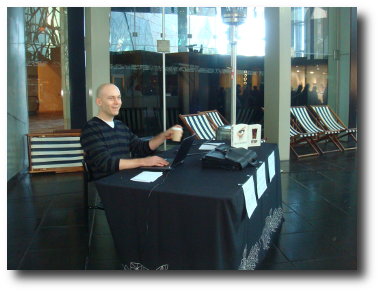
I knew it would be tough. Turning up at the Melbourne Writers Festival with a laptop, plugging into the big screen, and writing a short story from scratch while people watch: that’s not the recommended writing technique. I think that’s the opposite of what you’re supposed to do, which is something about forgetting the rest of the world exists. It’s hard to be creative and self-conscious.
But that was half the fun! Come watch Max struggle! I was already writing an online serial in real-time; how much worse could this be?
Lots. I turned up on the day, ready for action, at the table they’d set up. It was in the corner of the atrium, hidden behind the Festival’s Information Desk. On official maps, you couldn’t see it, because it was obscured by the word “INFORMATION.” This struck me as problematic. There was no signage to indicate who I was or what I was doing. Shortly after I began to set up, a man stopped and asked for directions to a panel. I decided it was time to make up my own signs. I did three, and stuck them to the front of the table: the first said, “Hi! I’m Max Barry.” The second said, “I’m writing a live short story today.” The third said, “Because I’m stupid, that’s why.” This turned out to be truer than I knew.
Half a dozen people had gathered. About this number stayed the entire three hours, and may I say to those people, I’m incredibly touched and grateful, even though you destroyed my sanity. There was nowhere for them to comfortably see the screen and me at the same time, but that didn’t deter them; oh no. They made the best of things, craning their necks and reclining chairs like they were beach lounges. That way, they could see pixelated, perspective-warped words on the big screen while staying close enough to make out the individual beads of sweat dripping down my nose.
But I’m getting ahead of myself. First I had to chase down Festival people, imploring somebody to plug me into the big screen like we had damn well arranged. I hate to knock the Festival, because it’s a great event, but this was really crap. People were waiting.
Once I was on the air, I canvassed my little audience for ideas. I got some great ones, some good ones, and some I still don’t understand today. The two that jumped out at me were both about pregnancy: one about a couple whose due date comes and goes, and goes and goes, and another about renting a baby. In retrospect, I probably should have been wary of both of these, because they’re similar to two other shorts I’ve written: How I Met My Daughter and A Shade Less Perfect. I was already defensive, feeling around for tried and tested tools.
But it was only 11:30am: I was full of energy, optimistic! When people came up and asked for directions, I tried to help them out, then went back to my notes. Sometimes I asked for feedback from the people standing around. Then I realized I didn’t have to: I could hear their reactions.
Let me say that again. I would type a sentence, and hear people inhale, or snicker, or lean together to discuss it. Now, I guess I knew this might happen. And, at first, while I was messing around with notes, it was funny. Even useful. But then I started writing. And it was like they were INSIDE MY BRAIN.
The longest I ever sunk into the story before remembering that people were watching was about 45 seconds. Often I would be halfway through a sentence and someone would stop by to chat or offer suggestions or ask where the bathrooms were. Which is what I signed up for, of course: this was meant to be interactive. But it was like being woken from a deep sleep eighty times an hour. Two parts of my brain that don’t normally meet were knocking into each other and I wasn’t sure which of them was me.
By the two-hour mark, I was flagging. The story wasn’t awful, but it didn’t feel right. It was derivative, of me; like something not new. I wasn’t connected to it. I had honestly tried to do this right, but if I’d been at home, at this point I would have closed the document and checked my email.
Since that would have been inappropriate with an audience, I ploughed on. At 2pm, I finished. I thanked everyone who had stuck around, and I meant it, even though I already knew I would be spending the next few days trying to scrub them out of my brain. Then I left. I felt like someone had beaten the creative part of my mind with sticks. The rest of the day, I struggled to talk like a human being. True, I have that problem normally. But this was even worse than usual.
The next time I sat down in my study, I felt them there: phantom story-watchers. Halfway through my first sentence, I almost braced for a snicker. But it didn’t come. After a while, I forgot about it. I was okay. I was safe again.
Stranged
 One
morning recently I climbed the stairs to my study, coffee in hand, and found a
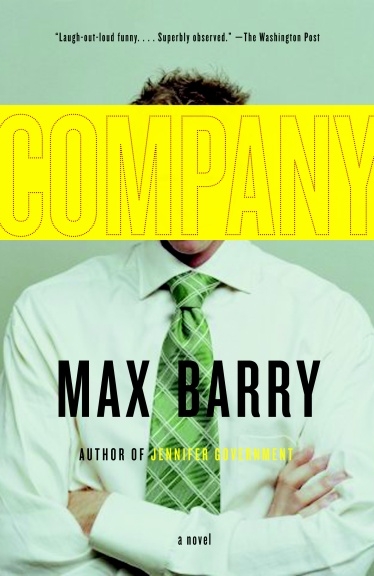
pile of books on the top step. There was a Swedish Jennifer Government,
a Polish Company, and four or five others. The front panel of my computer
case was missing: I eventually found it inside the roofspace, along with my Richmond
Tigers scarf.
One
morning recently I climbed the stairs to my study, coffee in hand, and found a
pile of books on the top step. There was a Swedish Jennifer Government,
a Polish Company, and four or five others. The front panel of my computer
case was missing: I eventually found it inside the roofspace, along with my Richmond
Tigers scarf.
I went back downstairs and confronted my daughter. “Have you been moving my things around?”
She grinned, one of those ridiculously beautiful ear-to-ear smiles, and said: “I stranged your room.”
Since then, Fin has stranged my study several more times. Once I heard movement up there, called out, “Are you strangeing my study?” and she giggled and admitted yes. She loves to strange.
Today she turns four. Happy birthday, bunny. Thank you for strangeing my life.
 23 comments
| MaxBarry.com ›
Max ›
Stranged
23 comments
| MaxBarry.com ›
Max ›
Stranged
Watch Me Write
Tomorrow I’m writing a short story in public. If you’re in Melbourne, you can stop by
and watch me do it. This is the plan: I turn up at
Federation
Square Atrium
11am Saturday with a laptop and no ideas. I plug the laptop into a projector,
to broadcast on the big screen hanging above my head. Then I spend the
next three hours drinking coffee, staring into space, and attempting to
write something.
I’ve wanted to do this for ages; in fact, in my first ever bookstore event (Union Square Barnes & Noble, NYC, 1999) I talked about how there should be bookstore writings, not readings. Because while I’m interested in what my favorite authors have to say, I’m really interested in how they work. I would love to see how they put a story together.
So this year I suggested it to the Melbourne Writers Festival, and they liked the idea enough to turn it into a 7-day spectacular: one writer embarrassing herself in public between 11am and 2pm per day. Saturday 22nd is my day, but you can also catch Eric Dando (today), Cyril Wong (Sunday 23rd), Reif Larsen (Thursday 27th), Evie Wyld (Friday 28th), Shaun Tan (Saturday 29th), and Jessa Crispin (Sunday 30th).
Clearly, this has the kind of potential for catastrophic public breakdown that I crave, so it should go well.
P.S. If you want to drop by at 11am and suggest some story ideas, that would be really handy.
A book deal for Charlie
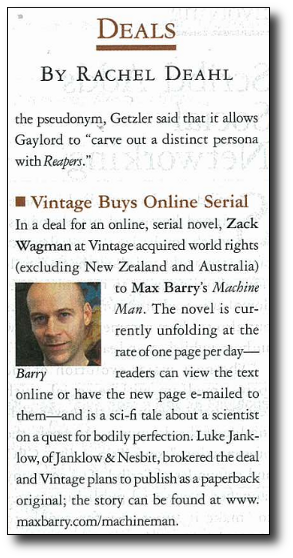 As
reported
in Publisher’s Weekly, Vintage Books will bring
Machine Man to life in print form in the US & Canada,
most likely in 2011. This will be a rewritten version of what’s
currently going up online—since I think the two mediums have very different
requirements, plus I haven’t yet seen a first draft I didn’t want to rewrite. Or
any draft, actually. But that’s my personal issue. So anyway, once I finish the serial,
probably later this year, I will start trying to figure out how the hell
I do that.
As
reported
in Publisher’s Weekly, Vintage Books will bring
Machine Man to life in print form in the US & Canada,
most likely in 2011. This will be a rewritten version of what’s
currently going up online—since I think the two mediums have very different
requirements, plus I haven’t yet seen a first draft I didn’t want to rewrite. Or
any draft, actually. But that’s my personal issue. So anyway, once I finish the serial,
probably later this year, I will start trying to figure out how the hell
I do that.
The particularly cool part is that Vintage (like Scribe in Australia & New Zealand) is happy for me to keep the serial online. Which may sound obvious to you, but that idea caused some publishing industry minds to EXPLODE. Their natural inclination is to scrub the internet free of any potentially competing versions whilst locking down e-books so tightly they don’t work on your device. That’s possibly just my bitter experience talking. But this is a significant step for a publisher, and I’m really happy Vintage took it. I didn’t want to take down my online serial. That would be like leading my child into a forest and abandoning her there. Then, I guess, going home and building a new child based on the first one. And offering her in print form. Wait. This analogy may have gotten away from me.
What we’ll have, then, is the original, unedited serial online, and a more polished (I was going to just say “polished,” but that could be a stretch) novel based on it. Given my track record of rewriting books until they cry, it will probably differ quite a lot from the serial. But on the other hand, it won’t have reader comments. Which is a shame, because those are awesome. It’s like book club five days a week.
This all makes a pretty amazing outcome for a project I started just because a reader bugged me. It’s been successful in a whole lot of ways. So thank you.
P.S. I can’t believe that Publisher’s Weekly’s “Deals” section, by Rachel Deahl, isn’t called “Deahls.” That’s a no-brainer.
P.P.S. My favorite sci-fi site just posted an article about this entitled “Max Barry Jams In Public, Creates A New Publishing Model, Slices Your Legs Off.” Ahh, bless your nerdy hearts.
Risk
Here’s me talking about risk:
(Link: Max Barry On Risk, ABC Fora or via The Monthly.)
Actually, first that’s Julian Morrow, introducing me. I feel I should point this out because you don’t see me very often, and even to me, all thirty-something white guys with no hair look the same.
Australians with digital TV can catch this on ABC2: an extract (I think) this Sunday at 6pm, and the full thing on Thursday at 5:30pm.
This lecture was for Sydney PEN’s Voices, and delivered at the State Library in Sydney on July 15, 2009. It’s not the kind of thing I usually do. In fact, it’s probably the first time I’ve been asked to write something serious since I became a novelist. It was a cathartic experience: I’m deeply grateful to have had the opportunity to do it, and to the audience on the night for being so supportive.
Me in the Media
As I write this, my intestines are trying to crawl out of my body. They’re
very determined. No, no, I don’t want your sympathy. Well, all
right, then. Maybe just a blanket. And my feet are kind of sore. You could rub
those.
But I’m not writing to let you know of my gastrointestinal issues. That’s just a bonus. I’m writing because I’m doing stuff:
Me on Australian TV: I’m a panelist on “Jennifer Byrne Presents: Brave New Worlds,” discussing Utopian/dystopian fiction. This is my first ever TV panel, and the more time that’s passed since it was taped, the surer I’ve become that I was A TOTAL DICK. But I’m hoping they edited those parts out. To find out, tune in to ABC TV at 10pm Tuesday.
Me speaking: I’m delivering two talks on “Risk” as part of the PEN Lecture Series, in Sydney (Wed 15th July, with The Chaser’s Julian Morrow) and Canberra (Tue 21st July, with Genevieve Jacobs). This will eventually be available on the web somewhere too, possibly here. Relatedly, here is me being interviewed about the upcoming lecture. Notice how carefully I speak while trying to hold my bowels together. That’s professionalism.
Now that’s real-time
Yesterday I did something very cool. You might not think so. If you’re the
sort of person who paraglides, for example. Or leaves the house most days.
But for me: totally exciting.
In the morning, I carried my coffee upstairs to my office and checked my email. This is almost always a bad idea, but still, hard to resist. I had a message from Meredith, who said she was very much enjoying Machine Man. That wasn’t the cool part. Well, it was. It’s always cool when someone tells you they like something you wrote. It never gets old. But what came next was even cooler: Meredith was a neuroscience major. She wrote:
I’m surprised he doesn’t have any phantom pain, since that’s extremely common; while the prosthetics would help trick the brain for sure, with that many limbs taken off, he would certainly have pain. No one totally understands phantom pain, but the idea is that our perceptions are not totally sensory; they are, in a large part, just our brain’s best guess. So, basically, the brain guesses that the limb is still there, but you can’t control it (unclench the phantom fist, etc.). A very simple technique has just been developed by Dr. Ramachandran at UCSD that is incredibly successful: Using a $5 drugstore mirror to make the arm that’s still there look like the arm that got cut off. This makes the brain think that what your one arm is doing, the phantom arm is doing. So those with phantom pain can get rid of an uncomfortable position.
I knew of phantom pain, of course, but thus far hadn’t thought of anything interesting to do with it. Now, thanks to Meredith, I did. Suddenly phantom pain seemed extremely interesting. So I opened up a blank page and began writing.
Often people email me interesting things about the subject areas in which I write. After Company, for example, I heard a lot of terrific workplace horror stories. Which is great, but I always think, “I wish I’d heard that two years ago.” Because then I could have used it in the book.
Yesterday, I sat at my desk with no idea what I would write for that day’s page, received an email from a neuroscience major, wrote something based on her insights, and published it. Then, to make it even better, the first reader comment (from always-interesting Pev) was: “Nice research on phantom limb pain, Max.”
This is the kind of research I can dig: the kind other people do for me, before I even know enough to ask. It’s not the first time it’s happened with this story. And it’s a totally unexpected side-benefit of the real-time serial format. I’m loving this.
Machine Man update
 Seriously:
I’m making this story up as I go. I didn’t say that just to lower your
expectations. It’s a work in progress. I haven’t plotted it out in advance.
I write each page a few days before you see it.
Seriously:
I’m making this story up as I go. I didn’t say that just to lower your
expectations. It’s a work in progress. I haven’t plotted it out in advance.
I write each page a few days before you see it.
I’d like to believe the reason I keep getting emails like, “Come on, tell me: how much of this have you written already?” is that people think Machine Man is so amazingly brilliant that no mere mortal could dream it up on the run. Unfortunately, I have to face the fact that you just think I’m shifty.
So look, I swear: it’s for real. I’ll show you the blank pages I haven’t written yet.
Anyway. Six weeks in, I’m thrilled. I like the story, I like checking the latest comments about each page, and 2,700 people have signed up for it. The unsubscription rate is 7%, meaning 93% of people who try it out via email stick with it, which I couldn’t be happier about. Well, I guess I could. 100% would be better. But maybe that 7% just changed email addresses. Or someone close to them died and they couldn’t handle any contact from the outside world for a while. You can’t rule that out.
Now some news:
Machine Man is going to be a book. You know, a real one. My Australian publisher, Scribe, decided there was no need to wait to find out whether the rest of the story—i.e. most of it—would be any good, and offered for print rights. That’s some pretty good blind faith right there. I’m touched but slightly afraid.
I did an interview on Machine Man for LiteraryMinded.
I’m enjoying this enough to see it though, so the end of the free feed is nigh. I’m thinking Chapter Ten; i.e. the last free page will be 43. That’s eight and a half weeks in, which seems about right. Actually, page 33 would have been a good place, story-wise, but I hadn’t gotten around to setting up PayPal. Soon, anyway, you’ll have the opportunity to pay $6.95 for the rest of the story. If it helps, you can think of me using that seven bucks to buy shoes for Fin. Look at her! Right now she has to walk around in baskets.
And a few thoughts:
My favorite chapter so far is Chapter Five, which contains my favorite page (20), which contains my favorite line (“Don’t do that thing.”). I realize this is something no self-respecting author should ever admit, but that line made me giggle like a child.
Biggest surprise was the reaction to page 23. I forgot that nobody but me knew that Lola was into prosthetics. I mean, really into them. And people liked this development. Which was great to discover, you sick bastards.
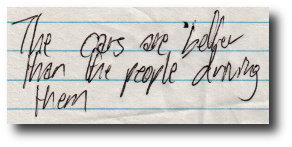
At the risk of disappointing you by revealing its very mundane origins: Page 21 is more or less the original idea I had for this story. I was walking along one day when I saw an unattractive man in a beautiful car; I had a notepad with me and wrote down: The cars are better than the drivers. I thought about this while waiting for the train, at which point I added: I want to be a train, which is essentially page 2. The rest follows naturally, I’m sure you’ll agree.
Terrifying Love
Forgive me, but I need to get this off my chest. I am a
Richmond Tigers fan.
That’s a football team. And by football, I mean Australian Rules. I don’t
want to get into a whole debate about which football code is best,
but it’s this one. Let’s just stipulate that and move on.
I began following the Tigers when I was about eight. Looking back, I think it was the exact moment they transitioned from a league powerhouse to the most spectacularly unsuccessful football team of the last quarter-century. I love the Tigers, but so far the journey has comprised three or four moments of ecstasy in an ocean of misery and despair.
Currently we are at the bottom of the ladder, with zero wins. We are probably about to sack our coach. I have been a strong supporter of our coach over the last five years, because he is smart. Our previous coach was not smart, and that didn’t work out so well. So this was a refreshing change.
But now I’m thinking smart is overrated. It’s useful. But it doesn’t seem to be as important to winning games as other qualities; in particular, being Terrifying and Lovable.
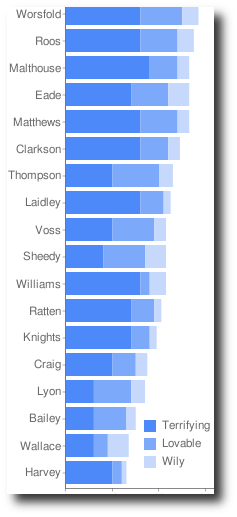 Because
I woke at 5AM this morning and couldn’t go back to sleep, I decided to rate
AFL coaches on those three dimensions. I scored a coach highly on
Terrifying if he is combative in interviews, physically intimidating, and
generally looks seconds away from pushing somebody’s head
through a wall. He scored Lovable points if he is the sort of bloke I
would want to share a beer with or invite home for dinner. And I awarded
Wily points if he is clever and tactical, both on match day and in the media.
Because
I woke at 5AM this morning and couldn’t go back to sleep, I decided to rate
AFL coaches on those three dimensions. I scored a coach highly on
Terrifying if he is combative in interviews, physically intimidating, and
generally looks seconds away from pushing somebody’s head
through a wall. He scored Lovable points if he is the sort of bloke I
would want to share a beer with or invite home for dinner. And I awarded
Wily points if he is clever and tactical, both on match day and in the media.
(Incidentally, my first thought was to rate coaches based on how many Google hits their names returned when coupled with relevant words. But I couldn’t find ones that worked. The word “tough,” for example, occurs frequently in articles about Richmond, but in contexts like “tough season,” “tough luck,” and “Convincing anyone to coach this club will be tough.”)
It turned out that Terrifying was about twice as important as Lovable in terms of modeling a coach’s success, and Lovable in turn was about twice as important as Wily. This explained a lot for me. Richmond’s current coach, Terry Wallace, is very Wily, but not very Terrifying, and a little too self-interested to be Lovable. Our previous coach, Danny Frawley, was very Lovable, but neither Terrifying nor Wily. And I suspect Lovable can only take you so far: if you keep losing games, you probably become rapidly less Lovable. Those coaches who have a significant impact in their first year or two, then are powerless to stop their team sinking down the ladder: I think they’re Lovable coaches losing their shine. And one more thing: this accounts for the vogue toward younger coaches. “Lethal” Leigh Matthews, an extremely successful coach over many years who was nonetheless replaced last year, was one of the most physically intimidating men the game ever produced, but at 57, he wasn’t getting any more Terrifying.
Based on this, I hope Richmond’s next coach will be Nathan Buckley. I have no idea whether he’s any chop as a tactician, but he seems like a really decent, stand-up guy who might, if you annoy him, tear off your arms. Perfect.
Memory Bones
 I
don’t want to freak you out, but MY DAUGHTER’S STRUCTURAL
INTEGRITY HAS BEEN BREACHED. Her bones have bent. One has cracked.
She has broken her arm.
I
don’t want to freak you out, but MY DAUGHTER’S STRUCTURAL
INTEGRITY HAS BEEN BREACHED. Her bones have bent. One has cracked.
She has broken her arm.
It happened at an indoor play center, one of those technicolor places with dizzying heights and terrifying drops, trampolines that launch children through the air like patriot missiles and treacherous plastic balls that sneak out of pits to slip beneath tiny sneakers. Naturally, Fin navigated these with contemptuous ease, then tripped over her own feet on a stretch of flat carpet. Exactly how you break an arm falling two and a half feet onto shag pile, I don’t know. But she wailed like… well, like she’d just broken her arm. When this didn’t abate, and I noticed her arm dangling at her side like a wet noodle, I began to suspect something was wrong. I sprang into action, demanding a refund from the play center. Well, it was five bucks. And we’d only just arrived. I don’t see why I should have to pay five bucks for eight minutes of fun, followed by a broken bone. They gave it to me, too, plus a voucher for a free coffee my next visit, in 4-6 weeks.
As soon as that was taken care of, I carried my screaming three-year-old daughter straight out of there. I didn’t have a car, so I bore her in my arms to the nearest hospital. I don’t want to claim I was a hero, but if anyone wants to make a movie of my life, that would be a really moving scene. I think there could be an operatic sound track at that point. That’s just a thought.
Fin stopped crying the second we stepped into the Emergency Room, which was a shame, because they decided she wasn’t urgent and told us to go to another hospital. I was tempted to pinch her, in the interests of securing prompt medical attention. But that might have been a difficult moment to explain in the movie. So off we went to the Royal Children’s Hospital, where they X-rayed her, pulled her bones straight, and encased her arm in plaster.
Let me tell you about this process. I’ll tell you the same way Dr. Elliot explained it to me, right before he began to inflict excruciating pain on my daughter: “We’ll give her some gas. It’s not for pain relief. What it does is block the formation of short-term memory, so when it’s over, she won’t remember what it was like.”
Now, I don’t want to criticize Dr. Elliot. He is a smarter, better-educated guy than me, and no doubt across the many excellent medical reasons why this is the optimum course of action for children. But if they suggested this idea to an adult patient, that person would PUNCH THE DOCTOR RIGHT IN THE MOUTH. Is this not the most horrible concept you have ever heard? “We won’t block your pain. We’ll just make you forget it afterward. It’s basically the same thing.” NO IT’S NOT. Option A: no pain. Option B: TONS OF PAIN. That’s the difference.
Fin sucked on that gas like she was drinking it. Dr. Elliot pulled her bones straight. “Daddy,” she cried out. “Daddy, I want you.” I squeezed her free hand and told her it was all right, and a few seconds later she had forgotten all about it. When they were finished, she smiled and said, “I like this hospital.”
I hope that creeps you out as much as it did me.
Lessons from the Machine
A writer friend emailed me about Machine Man:
I’ve managed to get to the FAQ, but am I REALLY supposed to believe what you have posted there?
I think he means that writing is a good way to send yourself insane before you ask everyone in the world to watch you work and post comments. True, it’s not a method I’d generally recommend. It’s essential to stay excited about a work-in-progress, and there may be no better way to deflate yourself about a promising story than to show it to people before it’s ready.
But I am a big boy. And I did set expectations before I started: this isn’t a plotted, edited, polished book. This is me caught in the act of making sausages. I think everyone understands that.
Ha ha ha! No, of course they don’t. And nor should you: all that really matters is whether the story is worth reading.
One week in, this is what I’ve found:
You people don’t miss a thing. Upon posting Page 4, I was immediately slammed by multiple readers for being repetitive, unimaginative, and suggesting that straight hair can dangle. This is slightly terrifying, because no doubt Page 4 is a lot better than some others I’ll serve up. But it’s also instructive. I think Machine Man is good training for me in the same way as a boot camp commander who makes you crawl through mud while screaming insults about your mother. They’re both… uh… character-building.
I am getting a lot of love for this project, which is flat-out wonderful. It’s thrilling to watch a page go up and read comments about it. Scary. But thrilling. There is usually a gap of several years between me giggling to myself in my study over a line, and anyone outside my immediate friends and family reading it. That immediacy of reaction is kind of addictive. Thanks.
Long-time meta-blogger Adam wrote:
I wonder what would happen if every day I tried to predict what will happen on the next page. I feel like it would really screw with Max as a writer.
Ha ha ha! It sure would! Although that is a fascinating thing for me: I have always wished I could stick probes in your brain to see how you react as you read my stories. Are you buying this particular subplot? Do you care? Did you notice that foreshadowing before; was that too obvious, or too subtle? Usually I have to bug Jen about these things. Here I feel closer to getting an answer to the eternal question: How does this book look when it’s inside your head?
Quite a few people seem frustrated at the one-page-per-day drip-feed. I’m not sure whether this is good frustration (“I love this story so much, I can’t wait for pages!”) or bad frustration (“In the 24 hours between each page, I totally forget everything that happened!”). I guess a little of each. I’m enjoying this format very much, but will wait and see how well it works for readers over the long-term.
GMail is really popular. Which is not particularly relevant, but wow: almost half of all subscribed email addresses are at gmail.com. Hotmail is a very distant second. There are about 1,500 people signed up to Machine Man at the moment, with… huh. I just double-checked my numbers, and it’s exactly 1,500 people. That’s a little weird. Anyway, 1,500 people, with three-quarters getting it via email and the rest via RSS. There might be others reading pages on the site without subscribing.
Since it’s been a happy beginning, I’ve decided to start a new Machine Man feed every Wednesday. So if you only stumbled across this concept today, you can still get Machine Man delivered starting from Page 1! Feel free to tell your friends about that.
Machine Man launch
Machine Man launches tomorrow! Which is also my birthday. Yeah, thanks for
noticing. No, no, don’t try to make excuses. It only demeans us both.
Speaking of which: Machine Man! I hope you’re signed up for this spectacular venture into real-time serial fiction. I say “spectacular” because “I wound up writing a 200-page story for eight interested readers” would qualify too, albeit not in the sense I’m hoping for. But either way.
Because the original concept wasn’t self-destructive enough, I decided each Machine Man page will accept your comments. That way, my eight interested readers can not only bankrupt me financially, but also destroy my creative confidence. There’s a very real chance here you may see me totally disintegrate as a human being. And I’ll throw that in for nothing.
P.S. I have to confess: I’ve cheated a little already. I got ahead of myself and built up a little stack of pages, which are now ready to go. It has been fun. There is something very satisfying about a solid, ninety-word scene. I think I like this medium. It’s like a novel with ADHD.
P.P.S. I got a spam email from “Mal Awesome.” That’s the best name I’ve ever heard. Next time I need a character name, I’m trawling my Junk folder.
This is the something
I’ve never
loved the idea of reading a novel online, because novels aren’t meant to
be read that way: they are designed to envelop you. Anything I see on
the web, by contrast, I give my attention for a maximum of eight seconds before
checking Reddit for videos of laughing dogs. Don’t say that’s just me.
It’s how the internet trains us.
So rather than trying to shoe-horn a novel into a web-friendly format, I thought I’d write you a real-time serial. That means a continuing story that turns up one tiny page at a time in your inbox. It is titled “Machine Man.”
I say “real-time” because I will write it as you read it. I’m warning you about this up-front because it’s going to be a little chaotic, and Hemingway was right. Also there is the possibility that it will go so badly I nuke this part of the web site and pretend it never happened. But it’s the web, right? So I will release early and release often.
Right now you can sign up for free. If it goes well, I’ll turn it into a subscriber thing where you can buy the whole thing for $6.95.
Pages start Wednesday March 18, 2009. You can find out more here.
I hope you like it.
P.S. I’m not sure if anyone’s done anything quite like this before. If they have, and it was a disaster, please don’t tell me.
P.P.S. Special thanks/blame to Ian for haranguing me into doing this.
Machinations
I have a problem. Lately I’ve been happy with my writing; I don’t want
to make a whole big thing out of it, but the words have
been good words. I like them. They make me happy. One day, not too
long from now, I hope other people will see them, and be happy, too.
I haven’t mentioned this recently—by “recently,” I mean, “for the last 18 months”—because I got myself into the slightly embarrassing situation of publicly declaring my excitement for a book that, in retrospect, didn’t quite deserve it. I don’t think I had gone through the essential “falling out of love” stage, which must occur so that an author can stop making goo-goo eyes at her new baby and start dismembering it, to build a new body around the interesting parts.
Also, I figured it’s frustrating to hear an author talking about how great his writing is going when he’s not putting out any frickin’ books.
But clearly this has backfired—or at least run its course. I first got an inkling when a friend sent me a podcast on “Writers and Procrastination.” Then there were the growing number of emails and comments, like this one from Ian:
What do you do all day? I read Twilight for frack sake. I’m so bored. And you….watch movies and grow facial hair? Books! WRITE BOOKS! Short stories…..anything
People think I’m not doing anything. It’s a little strange, because if I’m on book tour for some paperback edition, people seem to figure I’m at least keeping busy. But if I bunker down and write, they assume I’m sipping daiquiris in the Bahamas.
I decided to tally up the number of words of fiction I’ve ever written. It’s 1.5 million. My finished novels tend to wind up around 80,000 words, so that’s about 19 books. Since Company, I’ve written about half a million words, the equivalent of seven novels.
But not seven good novels. I’m a pathological rewriter: I believe that if a book hasn’t had more words cut from it than it is long, it needs more work. Right now, I have quite a lot of fiction that is promising. Some of it is almost there. But not quite. And I do not want to give you a bad novel. I never want to do that.
So here is my problem. Even if I escorted a manuscript to my publisher tomorrow, it would be a year, minimum, before that thing reaches your hands. It would make you happy, I think. But it’s a long time to wait. It’s too long.
So I am going to do something. I know what the something is. It will be good. And it will be in March.
The Dark Moustache of the Soul
I got into big trouble with my brother for
that anti-ginger blog.
“You’re just like Hitler,”
he said, or might as well have. “It’s not 1935, you know. Demonizing
people for aspects of their appearance they can’t control: we’re not doing
that any more.”
“Steady on,” I protested. “It was just harmless good fun. Besides, the point was I’m a ginger when I grow a moustache. That’s what made it funny.”
“I suppose you think Auschwitz would have been fine, if only Hitler was Jewish,” my brother argued, more or less. “I suppose you think it would have been hilarious.”
I suspected that my brother, or at least this version of him I was exagerating for comic effect, was getting carried away. But he did have a point. “Redheads are one of the few remaining groups it’s still socially acceptable to ridicule,” he said, and dammit, he was right. I had been so enraptured with the possibilities for jokes when I started sprouting gingers, I didn’t stop and think. My moustache was gone, but the dark moustache on my soul would not be shaved so easily.
“History is full of red-headed achievers,” he said. “You just never hear about them. Thomas Jefferson. James Joyce. Galileo. Malcolm X.”
“Malcolm X!? Are you sure?”
“Check it out for yourself.”
“Wow,” I said. “Maybe that’s why he was so angry.”
“You’re doing it again.”
“But I’m a ginger.”
“Let me explain this to you one more time.”
But seriously. Redheads rock. I love you guys. If I could grow long, amber locks, I’d be all over that. I’d let my beautiful red hair flow down to my shoulders and smell it every night before I went to sleep. Right now, I’ve got nothing. The difference between a red-haired guy and me is that he has options.
Thought for the Day
If an infinite number of monkeys working on an infinite number of
typewriters will eventually produce the complete works of Shakespeare,
a sufficiently powerful computer could auto-generate random combinations
of letters, numbers, punctuation, sounds, and pixel maps,
until it owns the copyright on every work of art that could ever be created.
One application of this machine would be to generate income by suing popular artists. Another would be to render all future art illegal.
Since going about your everyday life would inadvertently create an unauthorized performance of a copyrighted work, it would be illegal to do anything, at least for 120 years, except act out old books and films that had already entered the public domain.
Happy New Year!