






































Dear Warner Bros.
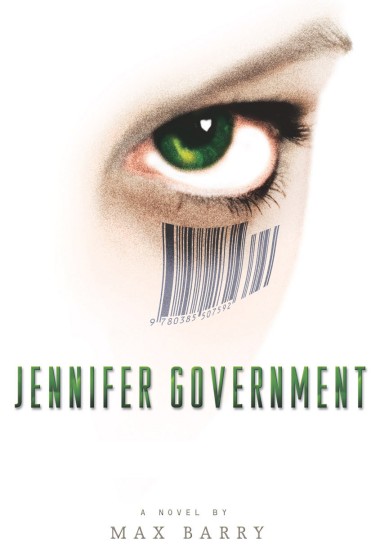
 You remember me. You bought the film rights to my novel
Jennifer Government,
for Steve Soderbergh and George Clooney. Didn’t work out, but
that’s not your fault. These things happen. I hope we can work again some day.
That’s not why I’m writing.
You remember me. You bought the film rights to my novel
Jennifer Government,
for Steve Soderbergh and George Clooney. Didn’t work out, but
that’s not your fault. These things happen. I hope we can work again some day.
That’s not why I’m writing.
I’m writing because yesterday I rented The Dark Knight, and I couldn’t watch it. I tried. But when I popped that DVD into my home theater PC and snuggled up on the sofa with my wife, it wouldn’t play.
At first I thought the disc must be damaged. I tried it in my laptop: no dice there, either. So I took it back to the video store and swapped it for a new one. They were very apologetic, by the way, Warners. I guess they understand that physically traveling to a bricks-and-mortar store is kind of a pain, and when you’re in business against digital downloads, you don’t want to make your transactions more difficult than they already are.
Home with my fresh DVD, I tried again. But still: didn’t work. A little Googling later, I discovered the disc was indeed damaged, and by who: you.
You’ve installed some new anti-piracy protection onto The Dark Knight DVDs, which prevents the disc from playing in my PC. Well, “prevents:” it took me an hour of messing around to figure out how to rip it. I didn’t want to rip it, Warners. I only wanted to watch it. I think it may actually be illegal to rip copy-protected DVDs where I live. But you engineered your disc so that it wouldn’t play in my DVD player: this was the only way I could access the content I’d paid for.
Now, I understand that home theater PCs are kind of new-fangled, Warners, and not everyone wants to watch their DVD on a computer or laptop. But some of us do, more every day. I think you need to get over the idea that PCs are just for pirates.
Please, help me out here: who does your protection scheme target? It can’t be the real pirates; they are barely slowed by such things, and you surely know this. If I’d wanted to download The Dark Knight illegally, it would have been quick and easy; there’s no shortage of places to find it, and the copies are high-quality. Unlike your DVD, they are also ad-free, play without a hitch, and would have spared me three trips to the video store.
I think your target must be the average consumer: someone with a PC and a legitimate copy of your DVD, but limited technical knowledge. This person will be defeated by your anti-piracy protection, at least for the moment. But what does this gain you? I’m honestly stumped. These are not the people who are distributing copies over the internet. They are, at worst, time-shifting a rental, or handing out a copy to their friends. A copy of a store-purchased DVD, that is. They are that tiny, precious slice of the population who has decided to give you their money: your customers.
When you optioned my book, Warners, I noticed the contract provided for a cut of the film’s eventual revenue to the MPAA. I felt a little uneasy at this, because even back then I wasn’t comfortable with the shenanigans that organization was up to. The unskippable copyright notices at the start of movies, for example: that’s half the reason I swapped to a home theater PC in the first place. There is something wrong, in my opinion, when a machine I purchased, playing a DVD I purchased, tells me I’m not allowed to use the fast-forward button.
I understand piracy is a serious problem for you. I really do. You’ll get no argument from me that wholesale downloading of copyright material easily available from legitimate channels is morally indefensible. If we can sensibly fix that, I’m right there with you. But you seem to be hell-bent on converting your entire customer base into pirates. You are facing competition that offers your product at zero cost and maximum ease of use, and you respond by breaking your own DVDs.
So, next film deal, I’m striking that clause out. No more MPAA funding from my material. And Warners, it’s not because I’m angry. It’s not because I want that hour back I spent trying to get your busted DVD to play. It’s because you need to stop this. Really, it’s for your own good.
The War on He
 I
was reasonably confident we had this whole gender inequality thing licked,
until I fathered a girl. I mean, I was aware things were
not perfect. I worked in corporate-land; women were clearly held to different
standards than men. But still: close enough, I thought. In the grand scheme,
there were bigger problems.
I
was reasonably confident we had this whole gender inequality thing licked,
until I fathered a girl. I mean, I was aware things were
not perfect. I worked in corporate-land; women were clearly held to different
standards than men. But still: close enough, I thought. In the grand scheme,
there were bigger problems.
Now I realize the smallest hint of sex discrimination is A GLOBAL CONSPIRACY TARGETING MY DAUGHTER. And it’s everywhere. Why is every animal assumed to be male? Why is “he” used interchangeably with “it” in a great swathe of children’s picture books? I’ll tell you why: because male is the default setting for everything, unless it’s soft and pink. Or a cat. I’m not sure why cats are the exception. But everything else is “he.”
I realized this was a problem when Fin began naming her teddies. I don’t mind her having boy teddies. Boy teddies are fine, in limited quantities. But she thought almost all of them were all boy teddies. That didn’t seem right. I realized I was doing that thing: using “he” as default. I had imprinted her.
So I switched defaults. It’s a simple rule: you assume that everything is female unless there’s clear evidence to the contrary. Animals, teddies, unseen car drivers: all girls. It proved surprisingly difficult. I’ve been doing it about a year and I still sometimes slip up.
I also began converting Fin’s teddies. Now, possibly I’m teaching her that boys sometimes spontaneously turn into girls. But I had to do something about that men’s club. She’s picked up on it: many of them now waver between male and female, according to Fin, and a few I think I’ve turned completely.
Just the other day we saw a dog in the street and Fin asked if it was a boy or a girl. I asked what she thought. “I think it’s a girl,” she said. That was new.
That’s why all my examples now are going to be “she.” I used to try to mix it up: a “he” example here, a “she” example there. To, you know, be balanced. But now I realize the world is full of “he.” I don’t need to add any more.
Next I plan to father an illegitimate child with a Kenyan and discover we still haven’t solved racism.
P.S. Last day of Movember! I’m so happy; I finally get to shave off this monstrosity. Look at me! I’m a broken man.

Mo Bad Blues


At first it wasn’t too bad. In the right light, my mo looked fairly legit. It was rough and tough and ready to rumble, just like you might think I am, if you don’t know me very well. Seven days in, I could even be considered debonair.


Then the gingers came in.

Now, I don’t have anything against the ginger peoples. Some of my best friends—well, no, all right, that’s not true. I shun them. But I have several close ginger relatives. Lovely people. Really courageous. Also, there’s no problem with ginger if you’re a woman. For chicks, red hair means: “I am so aflame with animal passion, I could burst into fire at any moment.” I think we can all agree on that. But on a man, ginger hair is not popularly translated as “fiery, dangerous love beast.” It’s more “weird pervert from Accounting.”
On top of that, I keep accidentally cruising for gay sex. I don’t mean to. I just haven’t adapted to the signals my mo is sending out. For example, on my run this morning, I jiggled my eyebrows in greeting to a runner passing by. Usually, this means, “Nice morning.” But now, apparently, it means, “Nice thighs.” At least, that’s what I’m getting from the look of terror that crossed the guy’s face.
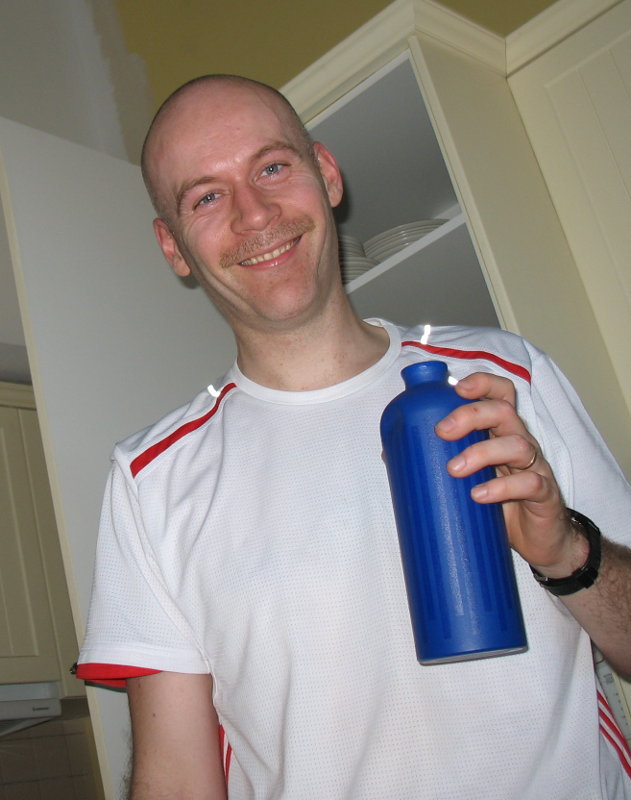
I’m beginning to catch glimpses of it in my peripheral vision. When I have a drink, it gets there before I do. The other day I blew my nose, and three hours later realized my upper lip was hoarding bits of tissue. Also, despite my private hopes, Jen has not been harboring a secret passion for circa 1970s tennis stars. Hairy, scratchy, ginger lip caterpillar: apparently not a turn-on.
It’s just as well I’m doing this for a good cause. Thanks so much to everyone who donated. I just want you to know, it’s because of you that I’m stuck with this thing until December.
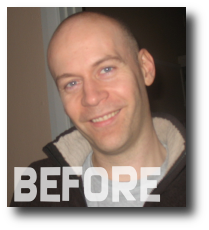
I’m growing a moustache
 “I’m
growing a moustache,” I told Jen.
“I’m
growing a moustache,” I told Jen.
“No you’re not.”
“It’s for Movember. You know about Movember?”
“I know Movember,” she said. “But no. You’re not growing a moustache. They’re creepy.”
“Jen! This isn’t about the moustache. It’s for a good cause. It’s about raising awareness. You think I want to grow a moustache? Do you? Like, what, as if I’ve always secretly wanted to, but until now been denied by social pressure? Honestly!”
She eyed me. “You don’t actually know what the cause is, do you?”
“Of course I do,” I said, offended. “Frankly, it’s that kind of attitude that makes it so hard to get this particular cause taken as seriously as, obviously, this particular cause demands.”
Jen sighed.
“I believe it’s something to do with prostate cancer,” I said. “But I have a whole plan. I’ll announce it on my web site, see, and people can sponsor me.”
“Sponsor your moustache.”
“Right! Yes! They can sponsor my moustache.”
“It’s not just prostate cancer,” Jen said. “It’s men’s health issues in general, including depression.”
“Well, there you go. You can’t say no to that.”
She sighed again. “You’d better get some donations.”
I Should Buy Some Cement

 I
should buy some cement, in case I need to hide a body.
I don’t plan on hiding a body. I have no particular body in mind.
But that’s the thing: if you wait until you’re there
with a bloodied lamp in one hand and a cooling body in the other, it’s
too late. You can’t jump in the car and head down to the
hardware store for cement at that point. You’d need to change your clothes,
stash the body somewhere it won’t arouse suspicion,
and this is assuming you can even get to an open hardware store.
It might be two in the morning. You might not have a car—or
you might, but with a fender caved in around a head-sized
crater, this being the reason why you need cement in the first place.
I
should buy some cement, in case I need to hide a body.
I don’t plan on hiding a body. I have no particular body in mind.
But that’s the thing: if you wait until you’re there
with a bloodied lamp in one hand and a cooling body in the other, it’s
too late. You can’t jump in the car and head down to the
hardware store for cement at that point. You’d need to change your clothes,
stash the body somewhere it won’t arouse suspicion,
and this is assuming you can even get to an open hardware store.
It might be two in the morning. You might not have a car—or
you might, but with a fender caved in around a head-sized
crater, this being the reason why you need cement in the first place.
And think about how bad it would look. You have to assume the police will investigate. At best, there’s a missing person, at worst, they already suspect homicide. “Where were you on the night of the 24th?” they’ll ask. If your answer is, “Buying cement,” you have a problem. Sure, you can lie. Say you were tucked up in bed. But that’s another thing to go wrong. Did you use your credit card to buy the cement? Did you visit an ATM for cash? They’ll find out. They’ll track down the clerk who served you. And that clerk will say, Yes, I do remember a sweaty, frightened-looking customer in urgent need of cement. I remember very well.
Consider how much better if you can simply trot down to the basement, flick on the light, and haul out those 60-pound bags of cement you stashed there for precisely such a contingency. No need to leave the house: just get mixing. You’ll have to pull up some floorboards, of course, or find a nice, quiet spot in the garden, and do quite a lot of digging. There is hard labor involved. I’m not saying it’ll be a breeze, something you can knock over before catching the end of Letterman and retiring to bed with a book. My point is when the payoff is avoiding spending the rest of your life in prison, it’s worth putting in some effort.
Like I said, I don’t plan on killing anybody. I’m a reasonable person. But I can’t say there’s absolutely zero chance that one day I’ll find myself with a dead body that needs hiding. I bet everyone thinks that, until it happens to them. It’s like insurance: I don’t really think my house will be destroyed by an earthquake, but I’m covered, just in case. Those kinds of things, I don’t like leaving to chance. I’m not a gambler. A bag of fast-setting cement retails for six dollars. A team of lawyers after the fact will cost me hundreds of thousands—and probably do less to keep me out of prison than timely application of cement. I think the economics speak for themselves.
Then there’s the peace of mind. You can’t put a price tag on that. Right now, even though I’m just home by myself, I feel a vague sense of unease. I know that through a series of strokes of misfortune, I could find myself with a body and no way to hide it. Having bags of cement in the basement, even though I’ll probably never use them, means I can relax. It’ll give me a warm feeling, just knowing they’re down there. Ready for a rainy day. I’m going to get some now.
The Ad About Nothing
Microsoft
has a new ad! And
experts are divided
over whether the quirky,
banter-heavy, no-need-to-mention-a-product spot is 90 seconds of
pure Seinfeldian genius, or a sad demonstration of what you get when
you try to advertise something that has no selling points.
Well, when I say “divided:” Microsoft thinks it’s pretty neat, and everybody else seems underwhelmed. In the face of this howling gale of criticism, Microsoft has responded: That’s just what we wanted! The ad is just a “teaser,” they say, meant to “get the conversation going.”
The Associated Press picked up this idea, ending its article with:
Even if the reaction was mostly negative, Microsoft’s ad has clearly succeeded in getting people talking.
And it popped up in lots of other places, too:
“It was a very odd commercial but it has the effect that people are talking about it now… so didn’t they get their money’s worth?” wrote ‘Amanda.’
I wonder when we can kill the idea that even colossal marketing blunders are secretly brilliant, since they at least got people’s attention. Because it sounds like I’m being asked to believe Microsoft deliberately blew $300 million as a strategic move to get everybody talking about what a waste of money that was. That must have been some pitch meeting. “Here’s our idea: a series of pointless, meandering ad spots that don’t actually promote your product, but spark worldwide debate about what the hell you thought you were trying to accomplish. Everyone will be talking about it!”
Presumably this firm would go on to promote Presidential candidates by having them drown puppies on live TV. You can’t beat that kind of exposure.
Personally, I don’t mind this ad. It’s the introduction of a long campaign; they’re just warming up. I’m prepared to believe it will be effective and entertaining. But if it sucks, that won’t mean it’s genius in disguise. It’ll just mean it sucks.
Orwell: Blogger
So are you following the
Orwell diary?
Me, I was in a state of near-sexual excitement
when I heard they were posting George Orwell’s 1938-1942 diaries online,
seventy years after he wrote them. But that’s a whole other story; back to
Orwell. Imagine! A peek at the intimate thoughts of one of the
20th Century’s literary giants: a man whose searing intelligence produced works of majestic
satire, whose vision seems to only grow more relevant.
What crackling intellectual thunderstorms, I wondered, raged inside this man’s head? In 1938, with a world war a mere twelve months away, what socio-political clouds did he see brewing? I signed up to the live feed right away. Orwell blogging: was there anything the man didn’t anticipate?
First entry, August 9: Orwell relates how he caught a snake. I wondered briefly whether this was a reference to the Munich Agreement—the snake could be Chamberlain or Hitler, maybe, even Daladier. But no. He was talking about an actual snake. Well, okay: I guess if I caught a snake, that would be exciting. I’m not sure I’d blog about it. But still. I could see, I suppose, that even one of the world’s great thinkers might, upon encountering a snake, temporarily cease pondering the human condition to remark, “Ooh, snake.”
Next entry, then:
August 10
Drizzly. Dense mist in evening. Yellow moon.
That’s the whole thing. All right, so maybe my expectations were a little high. He wasn’t writing essays. He was writing for himself. And the important thing wasn’t the prose; it was the train of thought.
August 26
Hot. Dense ground-mist early this morning. Many blackberries now ripe, very large & fairly sweet. Also fair number of dew-berries. Walnuts now nearly full sized. Plenty of English apples in the shops.
Lots of apples, really? Well, that’s… good, I guess. You need apples. The more the better. Especially in shops.
August 28
Night before last an hour’s rain. Yesterday hot & overcast. Today ditto, with a few drops of rain in the afternoon. The hop-picking due to start in about a week.
Hops-picking. You can’t begin looking forward to that too soon. Got to love the delicious anticipation of looming hops-picking.
August 29
Overcast & chilly. Heavy rain last night. Dahlias now in full bloom.
This was when I decided to claw out my eyes to relieve the boredom. At least then something would be happening.
They say you should never meet your idols, because you’ll only be disappointed. Maybe you shouldn’t read their diaries, either.
(Or their web sites, ha ha, yes, very clever.)
Making Sense of Babel
Atheism seems to be on the rise lately. I say this as someone who has examined no studies
nor historical data, but who reads a lot of web sites. I see more people more comfortable with declaring their atheism than ever before.
I think it’s at least partly because of the internet, which provides a
meeting-place for sharing and reinforcing ideologies:
that’s something new for atheists, whereas people of various faiths have always had churches, plus, in many places, pervasive support from their community.
And the internet is not only good at uniting geographically dispersed but like-minded people: it’s also disproportionately popular amongst people with technical and scientific backgrounds, who in turn are disproportionately atheist. So, on balance, the web seems to me to be a net negative for major religion.
Which got me thinking of the Tower of Babel*. According to the Bible, a great tower was built long ago in the city of Babylon; the builders of said tower were a little too pleased with themselves and their achievement, at least for God’s liking. There’s a whiff of the Titanic about this story: arrogance so great that it practically begs for comeuppance.
Which God delivers, of course. It didn’t take much to set God off in the Old Testament; he’d smite you for a backward look. But here, he reacts in a way that at first seems a little odd: no smiting, no plagues; he doesn’t even—stop me if I have this wrong—destroy the tower:
And the LORD said, Behold, the people is one, and they have all one language; and this they begin to do: and now nothing will be restrained from them, which they have imagined to do.
Go to, let us go down, and there confound their language, that they may not understand one another’s speech.
God is not concerned about the tower itself, or even the arrogance of its builders. That makes sense to me: you can be arrogant in any language, just look at France. God’s issue is with the ease of global communications.
So, as a story about the internet’s role in the decline of organized religion, the Tower of Babel makes perfect sense. I think that’s nifty.
(* Note: Religion is one of those touchy subjects you can’t write about without people looking for hidden agendas. Which is a shame, because religions are crammed full of stories that are interesting and meaningful regardless of how true you consider them to be. In the interests of full disclosure, I personally don’t believe the Bible to be a non-fiction work, but I hope that doesn’t bother you too much, and we can still be friends.)
House of Cuteness & Horror
A lot of parenting is like this: your gorgeous almost-three-year old daughter hops toward you, shouting, “Look, Daddy! Big jumps!” and you think: I hope she doesn’t trip and impale herself on that tree branch.
I don’t think I’m especially paranoid, but when I’m playing with Fin, I get flashes of her horrifically injuring herself about every ten minutes. When she actually does hurt herself, I’m mostly just relieved, because it’s so much better than it was in my head.
It’s a little weird to have your life filled with interlocking moments of joy and abject terror. They don’t mention that in the parenting books.
The other way parenting is like a horror show is how you periodically stumble past dolls arranged as crime scenes. Maybe it’s just me, but when I see something like this, I can’t help but think multi-vehicle pile-up:

And this strikes me not so much as “laundry day for Miffy” as “Hostel 3”:
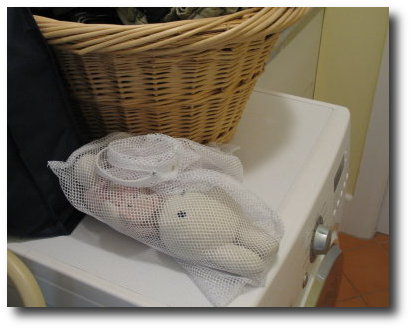
And I’m sorry, I know Baby Puss got wet in the bath and needed to be dried, but there is no way to look at this and not see a baby on a hook:
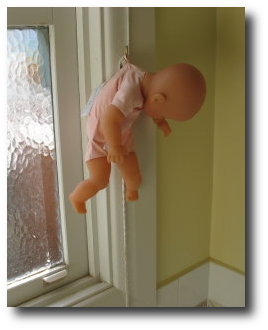
But then you see this and forget all about it.

By the way, sorry for that long break between blogs. What the hell was I doing? I don’t even know.
My Age of Reason
I’m not a superstitious person. But I do believe your brain can
come to associate particular objects with particular feelings, and
this can affect you in ways you don’t consciously notice. So today as
I prepared my morning coffee, I thought:
Did I have a good writing day yesterday? Because I used my
Richmond Football Club cup: they won on the weekend and thus I was
feeling good about them. It was a logical choice. But today: would there
be a carry-over effect, or would the cup have absorbed too many
new vibes from the day before, and if so, were they good vibes or bad?
At this point I realized that I was standing frozen in the kitchen with half a teaspoon of sugar hovering above the cup. I’m glad no-one saw this, because it might have been difficult to explain how I’m not a superstitious person.
Scraping the Barrel
I decided to stop doing those blog posts where I pontificate about
how the world should be. Because reading those back, they even annoy me.
And the ones that annoy me the most are when I start yapping about
politics. I mean, please, like the world needs another shrill, ignorant
opinion on that.
Well, maybe just one more. Don’t you think it’s strange how often people vote for somebody they don’t like? Elections should be simple, shouldn’t they? We vote for whoever we want to win, and the popular choice prevails. But in practice, you often have an incentive to vote “tactically.” For example, if you’re electing the US Democratic nominee, there’s no point voting for your favorite candidate if he or she has no chance of defeating the Republican nominee in the General Election. You should only vote for someone who can ultimately win. So now your vote has to not simply express your own preference, but be modified by what you believe everybody else prefers, too.
Anywhere there’s plurality voting, you can’t safely vote for your favorite candidate unless you’re confident enough other people will too. Otherwise, you’re smarter to vote for your least-hated candidate with a practical chance of victory. (Or vote swap.)
Now, in my experience, any time someone expresses an opinion they don’t personally have, but think others do, it’s a terrible opinion. For example, I’ve seen it produce some pretty ugly book covers. And I’ll ignore it in any reader feedback I get on my story drafts. People who try to guess what other people want end up settling on the dullest, most conservative, and uninspiring choice available, even if none of them personally prefer it.*
I get that there’s no such thing as a perfect voting system. Some are more warped than others, but, okay, it’s surprisingly difficult to create a fair, practical voting system. Still. How disturbing is it that on top of every other form of corruption inherent in the political process, it can be completely reasonable for you to walk into a ballot room and vote for someone other than who you want to win?
(* That’s one of the reasons Hillary got so close to Barack. There, I said it.)
Born Again
 When I was 23 and struggling to get anyone to notice I’d written a novel,
it annoyed the crap out of me to see so-called “Young Writer” prizes won
by 35-year-old guys with no hair. In which parallel universe, I wanted to know,
could those tottering old farts be considered young?
When I was 23 and struggling to get anyone to notice I’d written a novel,
it annoyed the crap out of me to see so-called “Young Writer” prizes won
by 35-year-old guys with no hair. In which parallel universe, I wanted to know,
could those tottering old farts be considered young?
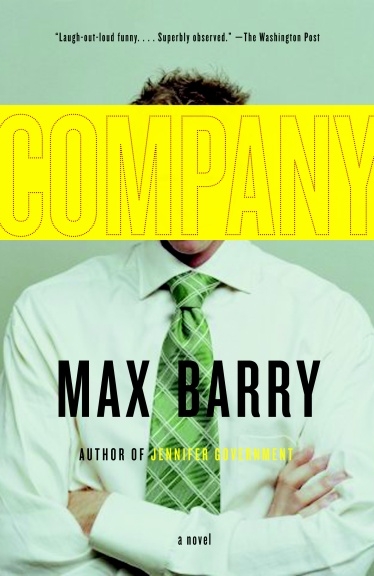
Which is why I’m so happy to be named among the Sydney Morning Herald’s Best Young Australian Novelists (for Company). Somewhere out there, a curly-haired 23-year-old is muttering about the unfairness of it all. Suck it up, punk.
Bad Potato
 I’m
feeling irritable. It started last night, halfway through a paragraph
of the book I’m reading. Usually I read at night until I realize I don’t
care any more, but last night I cared, I was just irritated. Not at the
book. Just in general. It is a non-specific irritability.
I’m
feeling irritable. It started last night, halfway through a paragraph
of the book I’m reading. Usually I read at night until I realize I don’t
care any more, but last night I cared, I was just irritated. Not at the
book. Just in general. It is a non-specific irritability.
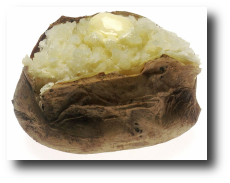
Now my question is: Why? Am I irritated at something, without realizing it? Is there some psychological problem here I’m in denial about? Or is it more like I ate a lot of starch yesterday, and tetchiness is a biochemical byproduct of my body processing it? I don’t want to dig around for emotional unrest if the real culprit here is a baked potato with bacon and cheese.
Do you think it’s possible to feel pissed at anything? As in, you tell yourself to start feeling irritable, then you try to think what you’re pissed at. Because I think I can do that. So are emotions responses to actual events, or does your brain grope around for convenient excuses for feelings that are more to do with random neurochemical tides?
If emotions are influenced by what you put into your body, is there any such thing as a “true” feeling? And if there’s not, is there any moral reason you wouldn’t, given the technology, pop a pill (or twist a dial) to generate whatever mood you want? Because that’s no different to having a coffee or a smoke, is it? But if we’re doing that—entering artificial states of feeling, emotions decoupled from the world—doesn’t that make us… well, unreal? Is there anything more fundamental to our existence than the validity of our own feelings?
I don’t know. It could be the potato talking.
 33 comments
| MaxBarry.com ›
Max ›
Bad Potato
33 comments
| MaxBarry.com ›
Max ›
Bad Potato
Advertising Next
Surely advertising is the world’s most inefficient industry. Here are people
who will plaster a bus with a
ten-foot-high pop-out poster of a giant on the off chance it will encourage
you to have your carpets cleaned.
Let’s walk through this process. For the ad to work, you must (a) notice it, (b) pay sufficient attention to absorb its message, (c) attach sufficient credibility to not immediately dismiss it, (d) retain that message until you enter a purchasing situation relevant to that product, and (e) find the message so persuasive that it alters the purchasing decision you would otherwise have made.
The chances of this are infinitesimal. And so advertising spams. It makes five hundred uninterested TV viewers sit through a 30-second spot in case one of them is in the market for a new SUV. The amazing part is that this is actually cost-effective. Advertising is a half-trillion-dollar industry that makes commercial sense even though most of its output is wasted.
Far more sensible would be if advertisers could restrict their ads to people likely to respond to them. They’d save bucketloads of money; we wouldn’t have to sit through ads for products we wouldn’t buy in a million years.
This yawning gap between the present state of the advertising industry and one that isn’t completely freaking insane means there will be change. Market segmentation has always been a big deal in marketing, but it’s getting huge. Marketers are ravenous for information about you, and they’re building immense data stores. These will enable them to tailor their messages to you—or, at least, to your market segment. In the short-term, it’ll mean more relevant ads, Google-style. Next, I think, comes more persuasive ads. That’s when they change not the product being advertised, but the message: playing up its green credentials if you’re environmentally conscious, its patriotism if you’re nationally minded, and so on.
Lately I’ve been thinking about my ideal state of advertising. And I don’t think it’s no ads at all. I would prefer no ads to the tidal wave of irrelevant ads I get currently, but in a perfect world, I do want information about products. Specifically, I want unbiased recommendations from people I respect and admire. That basically means friends and select celebrities. I want this to be “pull” information: I don’t want anyone randomly coming up and yakking about their amazing new phone. But if I’m thinking about a new phone, I’d like to be able to see what people with whom I identify think. I would like to browse through a list and see that Wild Pete has a Nokia but it sucks, Wil is wedded to his Motorola, and Stephen King knows where you can get a good deal on an iPhone.
The closest thing I’ve seen is Facebook. It’s all push—I get recommendations and links thrown at me whether they’re relevant or not, and almost entirely they’re not. But still, it’s socially-based purchasing advice. I think if Facebook had been smarter—if they’d remembered their success comes from giving people complete control over their own information, and hadn’t tried to wrest it back—they could have built the most effective, highly-targeted advertising platform in the world. Maybe they still will.
Until then, I’m skipping TV ads on my PVR, blocking them on the web with my browser, and listening to commercial-free internet radio.
The United Nations vs Me

 The
other day I was digging through my Junk folder when I found an e-mail from the
United Nations. I know what you’re thinking: “Wow! That is one politically astute
mail filter.” But pretty much all email to my public address without the
word “duck” in the subject, as per
my contact page,
gets flagged as spam, and the UN chose not to do that. Apparently arbitrary
yet effective protocols for ensuring open communication aren’t something
the UN wants anything to do with. Or maybe they have something against
ducks. I don’t know. Whatever the reason, they went with the subject,
“Notice of cease and desist.”
The
other day I was digging through my Junk folder when I found an e-mail from the
United Nations. I know what you’re thinking: “Wow! That is one politically astute
mail filter.” But pretty much all email to my public address without the
word “duck” in the subject, as per
my contact page,
gets flagged as spam, and the UN chose not to do that. Apparently arbitrary
yet effective protocols for ensuring open communication aren’t something
the UN wants anything to do with. Or maybe they have something against
ducks. I don’t know. Whatever the reason, they went with the subject,
“Notice of cease and desist.”
Naturally, it was about NationStates. It’s always about NationStates. I have Nike shooting teenagers and Coke marketing Fukk, that’s no problem. But one player says something mean to another in my web game and they’re going to sue me into oblivion. Anyway, what upset the United Nations was that I put them into NationStates. It’s the place where players come together to debate and pass international law; in the five years the game has been running, they’ve implemented privacy safeguards, promoted religious tolerance, passed a universal bill of rights, and outlawed child labor, amongst 240 other resolutions.
Clearly this wasn’t anything the real UN wanted to be associated with:
Dear Mr. Barry,
It has come to our attention that you are operating an online game called “NationStates”, www.nationstates.net, and that this game uses the UN name and emblem, without authorization…
We therefore demand that you immediately cease and desist from using the United Nations name and emblem in the above-referenced online game, and that in the future you refrain from using or making any reference to them in connection with your activities.
[ Full Letter ]
My first reaction was pride. Receiving a threatening letter from the United Nations; I finally felt like I’d done something with my life. Also, there is something inherently amusing about UN threats. I mean, I think the UN does a lot of great work, but let’s face it, they tend to specialize in demands backed by the threat of further, even more stridently voiced demands. Frankly, “You are hereby ordered to cease and desist” was a lot scarier before I got to “says the UN.”
But they did have a point. In 2002, I whacked the United Nations into my game, complete with copyrighted emblem, not so much in parody as to say, “Hey, look, this is just like the real UN.” I can’t remember ever thinking about the legal consequences; I probably assumed that even if the UN noticed, they’d have plenty of blood-thirsty dictators and international war crimes to prosecute before me. But what with Saddam behind bars and all that world peace you’ve been hearing so much about, I guess they worked their way down to me.
I wondered whether it was worth fighting. It would probably be eight years before they got inspections organized, and by then I could keep moving my UN references around where they wouldn’t find them. And it could be great fun. I could represent myself and wear cheap suits and tell the court that it was on trial. But for that to work, I would need an opponent who might actually be embarrassed by the expense and public profile involved in a petty IP lawsuit, and I just wasn’t confident the UN falls into that category. That the single biggest label on the front page of the UN web site is “Copyright, United Nations, 2008” struck me as an ill omen. Also, I do support the UN. I mean, sure, it’s about as functional as a cat with 192 heads, and a lot of those heads are corrupt. But at least they’re trying. At least the heads have to look at each other. I feel like if I’m going into legal battle with somebody, it probably shouldn’t be an organization whose foremost goal is world peace.
Plus I got a lawyer’s opinion, and he said I was blatantly in the wrong. So I decided to cave.
So now I have to rename my UN. I was tempted to go with something a little insulting, like “Discordant Nations,” or “Ridiculously Petty Bureaucracy of Nations Who Should Have Better Things To Do.” But no, that would be sinking to their level. NationStates now has a “World Assembly.”
I have chickens
 I
am renting some chickens. They’re out there right now, scratching in the
grass outside my study window. You might not have known you
can rent chickens—I didn’t, until Jen came home one day with shining
eyes and said, “Let’s rent some chickens!” But you can. In fact,
there is hot competition in the chicken rental industry, with
BookAChook.com.au,
RentAChook.com.au, and
CityChicks.com.au
competing in my local area alone.
I
am renting some chickens. They’re out there right now, scratching in the
grass outside my study window. You might not have known you
can rent chickens—I didn’t, until Jen came home one day with shining
eyes and said, “Let’s rent some chickens!” But you can. In fact,
there is hot competition in the chicken rental industry, with
BookAChook.com.au,
RentAChook.com.au, and
CityChicks.com.au
competing in my local area alone.
I wasn’t so sure about renting chickens, but Jen said, “If it doesn’t work out, we’ll just send them back.” That was when I realized how ingenious the scheme is. You can’t say no to rental chickens. It’s a risk-free investment. And so one night a nice lady drove to our house with a chicken coop, a bag of feed, some hay, and Patsy and Flo.
We didn’t name the chickens. They came with little cards with their names and pictures on them, like baseball stars. They’re basically celebrity chickens, on tour. I could tell they were VICs because Deb, the BookAChook lady, didn’t really want to hand them over. As she went through the list of rules (do not feed meat to chickens, do not feed eggs to chickens unless they have been well-disguised, on hot days chickens enjoy settling in with a chilled ice bottle), I could sense her judging me, evaluating whether I was chicken-worthy.
We’ve had them a few weeks now, and I have to say, I’m impressed. They are very low-maintenance: you let them out of their coop in the morning, you lock them up again when they wander back in at night, but except for chilling the odd ice bottle, that’s pretty much all you have to do. They don’t make much noise, although they have begun giving quiet, hopeful squawks every time I come out the door, just in case I have a plate of strawberries. That’s quite nice, to arouse a hopeful feeling in another creature, even if it’s just because of strawberries. I think it was definitely time I got a pet. And on current form, I can recommend you try the chicken.
Local Author Manipulates Way to Victory

 I won!
Thanks to
your votes, many of which probably came from
outside my home state and thus were blatant moral, if not
technical, violations of the competition’s integrity,
Company
rode to joint victory as the State Library of Victoria’s “Most
Popular Book.”
I won!
Thanks to
your votes, many of which probably came from
outside my home state and thus were blatant moral, if not
technical, violations of the competition’s integrity,
Company
rode to joint victory as the State Library of Victoria’s “Most
Popular Book.”
Now, some might view this as a shameful exercise in depriving a more deserving author of their rightful prize. Possibly this group includes the State Library, since they declared me “Joint Winner,” implying quite the statistical event. But no, no, I have to take their word for it that there really was a genuine tie. This makes me pretty glad I voted for myself. And means that my wife—who the morning of the award ceremony said, “I was supposed to vote?”—is in big trouble.
I didn’t mention this in my acceptance speech. What I did say, and would like to repeat here for those who (ahem) couldn’t make it to the ceremony, is that it’s continually amazing to me that people read something I wrote and care enough about it or me to send me an email, or mention it on their blog, or vote in a competition like this. I get so much personal joy out of writing, but to feel that response from people as well is truly touching, and makes what I do a privilege.
While I’m talking home town news, I’m stepping out for the launch of the new Australian Syrup edition, Wednesday 12th March, 6:30pm in the Sun Theatre foyer, 10 Ballarat St, Yarraville. They say “bookings are essential” (03 9689 0661), but I don’t know about that. I mean, it’s a foyer. And it’s me.
By the way, I just moved house, and I’m writing this blog on dial-up. Dial-up! It’s like being blind.
Dear Leader
 As
a parent, I occasionally wonder where Fin might end up in life. She’s
only two and a half, but I can’t help think about what
kind of job she might gravitate toward. Based on recent trends, I would
say she’s shaping up for a career as “Iron-Fisted Dictator.”
As
a parent, I occasionally wonder where Fin might end up in life. She’s
only two and a half, but I can’t help think about what
kind of job she might gravitate toward. Based on recent trends, I would
say she’s shaping up for a career as “Iron-Fisted Dictator.”
I’ve always been interested in social systems; I just never thought I’d get to see the rise of fascism up close. In the beginning, it seemed like nothing was wrong—sure, our small society was changing, but these were just natural responses to a changing world. Then one day we woke up and realized that every part of our lives had fallen under the sway of an increasingly irrational authoritarian overlord.
We vaguely remembered that life had not always been like this; that there had been a time when we had been free to express opinions such as, “I think it’s time for bed,” without fear of reprisals. In those days, we had been active participants in the decision-making process. We could go about our daily business without being stopped and asked to explain and justify our every action. But those days were over.
Looking back, I missed the early signs. One day, for example, I said, “Finlay, no feet on the table during lunch, please.” She responded by raising her feet approximately one inch above the table surface. “My feet aren’t on the table, Daddy,” she said, in the tone of someone just as amazed as I was. At the time, I was quietly impressed at her burgeoning ability to adhere to the letter of the law while flagrantly violating its spirit—I thought she was just shaping up to be a good lawyer. What I failed to realize was that testing the legal boundaries is classic behavior of the tyrant in training. Sure enough, the next step was the declaration of a state of emergency and the suspension of all civil liberties. And there we were, living under a regime that would make Mugabe blush.
It was because of those Little Princess books. Fin read a few tales of this loud-mouthed, demanding little girl who lives in a castle with a full staff of adults who rush to fulfill her every wish, and she decided that sounded like a blueprint for an ideal society. I tell you, Little Princess is like Mein Kampf for two-year-olds. We got those poisonous tracts out of the house right away, but it was too late: she had a vision.
Since then we’ve made progress. One of the most effective ways to fight tyranny, I found, was to not give the tyrant her pack of Wiggles stickers until she says, “Daddy, could you please give me my Wiggles stickers?” This was a big improvement on previous forms of request (“I WANT WIGGLES STICKERS!”), and proof, I feel, of the effectiveness of economic sanctions.
Now the air rings with, “Daddy, could you please…” She has figured out that I won’t refuse any request that begins that way. I have to wonder: as we shed the shackles of totalitarianism, are we are seeing the rise of special interest pleading?
My Top Video Games
A few nights ago, Jen, Moo (Jen’s brother), and I got to talking about
our all-time top computer games. Naturally, this quickly devolved
into a bitter, insult-strewn debate about whose top-ranked games
were ground-breaking titans of their time (mine), and whose were
mindless, derivative trifles (theirs, except where overlapping with mine).
We did settle on the criterion that we should rank games based on the impact they had on us personally. This still left plenty of room for argument. Initially we were going to pick our top 5, but this got pushed out to 10. I still had too many classics left over, so successfully argued for 15, plus an “Honorable Mention.”
Three days later, we were still debating and re-arranging our lists. Clearly this was an important topic for us. In fact, it was surprising how much we cared. Games aren’t usually considered up there with books or movies, but these ones all meant a lot to us. They left a lasting impression and we wanted to give them their due.
So here is the result. My list:
- Elite (1984, Commodore 64): My mother bought me this for Christmas when I was about 11. I don’t think I did anything else that year. I never made it to “Elite” status, though. At least, not in the game. Ha ha!
- Doom (1993, PC): Ranked this highly for the multiplayer: Jen and I played together. Not competitively. Oh no. Jen lacks that part of the brain that lets you distinguish between reality and a computer game, which means if we play head-to-head, she tries to kill me in real life. We play co-operatively. (Fifteen years of marriage, bud. Fifteen years.)
- Shattered World (1990, MUD): A MUD is an online text-based game, usually swords-and-sorcery based. You type in commands, like, “kill goblin”, and read the responses, like, “The goblin dodges your swing. The goblin cleaves your head from your shoulders. You die.” I wrote tons of content for this game when I should have been studying for my marketing degree.
- Age of Empires II (1999, PC): I wrestled with the ethics of including a sequel when the original was much more, uh, original. But while Jen and I lost countless hours to both, this is the one we really pounded. Our strategy to defeat the computer-controlled hordes was to pour arrows upon the endless tides of units throwing themselves against our walls until our opponents had consumed every single resource in the game, reducing themselves to small groups of peasants standing around with nothing to do. Then we would ride out and butcher them.
- Half-Life (1998, PC): I was roundly ridiculed by Jen and Moo for not fitting HL2 into my list as well, but although it’s an amazing technical achievement, I didn’t really feel it, you know? No, Jen and Moo didn’t buy that, either.
- Paradroid (1985, Commodore 64): Ah, brave little 001 droid. I used to get up at 5am to play this before school.
- Portal (2007, PC): The only game I’ve played through since Fin was born. Portal is wonderful. I especially love how its story evolves from nowhere.
- NetHack (1987, PC): Sadistically difficult game that can strike terror into your heart by revealing a “D”.
- Warcraft II (1995, PC): The reason that for about five years there every single game on the shelves was a Real Time Strategy. Zug zug!
- Diablo (1996, PC): Diablo II was fantastic, too. But this game I knew I wanted the second the demo loaded.
- Unreal Tournament (1999, PC)
- Rygar (1986, Arcade)
- Battlefield 1942 (2002, PC)
- Defender of the Crown (1986, Commodore 64)
- Speedball (1988, Commodore Amiga)
Honorable Mention: Half-Life 2.
Obviously the mid-80s were very good to me. For comparison, here is Jen’s list: (1) Battlefield 1942 (2) Age of Empires II (3) Diablo 2 (4) Doom (5) Age of Empires (6) Warcraft 2 (7) Prince of Persia (8) SimCity (9) Railroad Tycoon (10) Carnival [for Colecovision] (11) Diablo (12) Venture [for Colecovision] (13) World of Warcraft (14) Warcraft 3 (15) Pancake [Vtech]. Honorable Mention: LadyBug [for Colecovision].
And Moo’s list: (1) Counter-Strike: Source (2) Team Fortress 2 (3) Runescape (4) Dynasty Warriors [for PlayStation 2] (5) Unreal Tournament (6) Half-Life 2 (7) Warcraft 3 (8) The Sims (9) Diablo , (10) Portal (11) Freelancer (12) Populous (13) Age of Empires II (14) Driver [for PlayStation] (15) Hitman: Blood Money. Honorable Mention: DragonBall Z [for PlayStation 2].
Moo is a teenager, by the way. You might have guessed that already.
Vote Early, Vote Often
Until recently I was a complete unknown in my home country of Australia,
while enjoying in the US a level of fame I would characterize as
slightly less completely unknown. This gripping irony unfolded
last year when I switched local publishers to Scribe, a feisty upstart
with the crazy idea of getting me to do some publicity.
So it was that I ended doing a lot of interviews in which I talked about how I did no interviews in Australia, and wasn’t that weird, what with me being slightly less completely unknown in the US and all. Scribe is planning to re-publish Syrup in a few months, and now my publicist is frantic because with that angle exhausted, there’s nothing interesting left about me.
I am now so slightly less completely unknown, in fact, that the State Library of Victoria—that’s my home state—even noticed I had a book published. This is exciting not just because it’s a great way to encourage people to read my book in a way that generates no sales. They’re also running a competition inviting you to vote for your favorite book.
I wasn’t sure it was ethical to ask my readership, the vast majority of whom reside outside Victoria, to vote for me in what seems intended as a purely local poll. But I asked Scribe, and they said, “Hell, yes. See if they can vote multiple times, too.” So I guess it’s okay.
In other local news, I’m doing a reading from Company at Brighton Library on Thursday 31st January 2008 at 6:30pm. I’m also reading my short story A Shade Less Perfect at the launch of The Sleepers Almanac on Wednesday 6th February 2008 at 6pm in the Bella Union Bar at Trades Hall, cnr Victoria and Lygon St, Carlton. Aloud, I mean. I’m not just sitting there, quietly turning the pages. I’m a professional.