





























My Age of Reason
 I’m not a superstitious person. But I do believe your brain can
come to associate particular objects with particular feelings, and
this can affect you in ways you don’t consciously notice. So today as
I prepared my morning coffee, I thought:
Did I have a good writing day yesterday? Because I used my
Richmond Football Club cup: they won on the weekend and thus I was
feeling good about them. It was a logical choice. But today: would there
be a carry-over effect, or would the cup have absorbed too many
new vibes from the day before, and if so, were they good vibes or bad?
I’m not a superstitious person. But I do believe your brain can
come to associate particular objects with particular feelings, and
this can affect you in ways you don’t consciously notice. So today as
I prepared my morning coffee, I thought:
Did I have a good writing day yesterday? Because I used my
Richmond Football Club cup: they won on the weekend and thus I was
feeling good about them. It was a logical choice. But today: would there
be a carry-over effect, or would the cup have absorbed too many
new vibes from the day before, and if so, were they good vibes or bad?
At this point I realized that I was standing frozen in the kitchen with half a teaspoon of sugar hovering above the cup. I’m glad no-one saw this, because it might have been difficult to explain how I’m not a superstitious person.
Scraping the Barrel
 I decided to stop doing those blog posts where I pontificate about
how the world should be. Because reading those back, they even annoy me.
And the ones that annoy me the most are when I start yapping about
politics. I mean, please, like the world needs another shrill, ignorant
opinion on that.
I decided to stop doing those blog posts where I pontificate about
how the world should be. Because reading those back, they even annoy me.
And the ones that annoy me the most are when I start yapping about
politics. I mean, please, like the world needs another shrill, ignorant
opinion on that.
Well, maybe just one more. Don’t you think it’s strange how often people vote for somebody they don’t like? Elections should be simple, shouldn’t they? We vote for whoever we want to win, and the popular choice prevails. But in practice, you often have an incentive to vote “tactically.” For example, if you’re electing the US Democratic nominee, there’s no point voting for your favorite candidate if he or she has no chance of defeating the Republican nominee in the General Election. You should only vote for someone who can ultimately win. So now your vote has to not simply express your own preference, but be modified by what you believe everybody else prefers, too.
Anywhere there’s plurality voting, you can’t safely vote for your favorite candidate unless you’re confident enough other people will too. Otherwise, you’re smarter to vote for your least-hated candidate with a practical chance of victory. (Or vote swap.)
Now, in my experience, any time someone expresses an opinion they don’t personally have, but think others do, it’s a terrible opinion. For example, I’ve seen it produce some pretty ugly book covers. And I’ll ignore it in any reader feedback I get on my story drafts. People who try to guess what other people want end up settling on the dullest, most conservative, and uninspiring choice available, even if none of them personally prefer it.*
I get that there’s no such thing as a perfect voting system. Some are more warped than others, but, okay, it’s surprisingly difficult to create a fair, practical voting system. Still. How disturbing is it that on top of every other form of corruption inherent in the political process, it can be completely reasonable for you to walk into a ballot room and vote for someone other than who you want to win?
(* That’s one of the reasons Hillary got so close to Barack. There, I said it.)
Born Again
 When I was 23 and struggling to get anyone to notice I’d written a novel,
it annoyed the crap out of me to see so-called “Young Writer” prizes won
by 35-year-old guys with no hair. In which parallel universe, I wanted to know,
could those tottering old farts be considered young?
When I was 23 and struggling to get anyone to notice I’d written a novel,
it annoyed the crap out of me to see so-called “Young Writer” prizes won
by 35-year-old guys with no hair. In which parallel universe, I wanted to know,
could those tottering old farts be considered young?
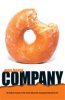
Which is why I’m so happy to be named among the Sydney Morning Herald’s Best Young Australian Novelists (for Company). Somewhere out there, a curly-haired 23-year-old is muttering about the unfairness of it all. Suck it up, punk.
Bad Potato
 I’m
feeling irritable. It started last night, halfway through a paragraph
of the book I’m reading. Usually I read at night until I realize I don’t
care any more, but last night I cared, I was just irritated. Not at the
book. Just in general. It is a non-specific irritability.
I’m
feeling irritable. It started last night, halfway through a paragraph
of the book I’m reading. Usually I read at night until I realize I don’t
care any more, but last night I cared, I was just irritated. Not at the
book. Just in general. It is a non-specific irritability.
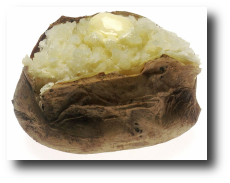
Now my question is: Why? Am I irritated at something, without realizing it? Is there some psychological problem here I’m in denial about? Or is it more like I ate a lot of starch yesterday, and tetchiness is a biochemical byproduct of my body processing it? I don’t want to dig around for emotional unrest if the real culprit here is a baked potato with bacon and cheese.
Do you think it’s possible to feel pissed at anything? As in, you tell yourself to start feeling irritable, then you try to think what you’re pissed at. Because I think I can do that. So are emotions responses to actual events, or does your brain grope around for convenient excuses for feelings that are more to do with random neurochemical tides?
If emotions are influenced by what you put into your body, is there any such thing as a “true” feeling? And if there’s not, is there any moral reason you wouldn’t, given the technology, pop a pill (or twist a dial) to generate whatever mood you want? Because that’s no different to having a coffee or a smoke, is it? But if we’re doing that—entering artificial states of feeling, emotions decoupled from the world—doesn’t that make us… well, unreal? Is there anything more fundamental to our existence than the validity of our own feelings?
I don’t know. It could be the potato talking.
 33 comments
| MaxBarry.com ›
Max ›
Bad Potato
33 comments
| MaxBarry.com ›
Max ›
Bad Potato
Advertising Next
Surely advertising is the world’s most inefficient industry. Here are people
who will plaster a bus with a
ten-foot-high pop-out poster of a giant on the off chance it will encourage
you to have your carpets cleaned.
Let’s walk through this process. For the ad to work, you must (a) notice it, (b) pay sufficient attention to absorb its message, (c) attach sufficient credibility to not immediately dismiss it, (d) retain that message until you enter a purchasing situation relevant to that product, and (e) find the message so persuasive that it alters the purchasing decision you would otherwise have made.
The chances of this are infinitesimal. And so advertising spams. It makes five hundred uninterested TV viewers sit through a 30-second spot in case one of them is in the market for a new SUV. The amazing part is that this is actually cost-effective. Advertising is a half-trillion-dollar industry that makes commercial sense even though most of its output is wasted.
Far more sensible would be if advertisers could restrict their ads to people likely to respond to them. They’d save bucketloads of money; we wouldn’t have to sit through ads for products we wouldn’t buy in a million years.
This yawning gap between the present state of the advertising industry and one that isn’t completely freaking insane means there will be change. Market segmentation has always been a big deal in marketing, but it’s getting huge. Marketers are ravenous for information about you, and they’re building immense data stores. These will enable them to tailor their messages to you—or, at least, to your market segment. In the short-term, it’ll mean more relevant ads, Google-style. Next, I think, comes more persuasive ads. That’s when they change not the product being advertised, but the message: playing up its green credentials if you’re environmentally conscious, its patriotism if you’re nationally minded, and so on.
Lately I’ve been thinking about my ideal state of advertising. And I don’t think it’s no ads at all. I would prefer no ads to the tidal wave of irrelevant ads I get currently, but in a perfect world, I do want information about products. Specifically, I want unbiased recommendations from people I respect and admire. That basically means friends and select celebrities. I want this to be “pull” information: I don’t want anyone randomly coming up and yakking about their amazing new phone. But if I’m thinking about a new phone, I’d like to be able to see what people with whom I identify think. I would like to browse through a list and see that Wild Pete has a Nokia but it sucks, Wil is wedded to his Motorola, and Stephen King knows where you can get a good deal on an iPhone.
The closest thing I’ve seen is Facebook. It’s all push—I get recommendations and links thrown at me whether they’re relevant or not, and almost entirely they’re not. But still, it’s socially-based purchasing advice. I think if Facebook had been smarter—if they’d remembered their success comes from giving people complete control over their own information, and hadn’t tried to wrest it back—they could have built the most effective, highly-targeted advertising platform in the world. Maybe they still will.
Until then, I’m skipping TV ads on my PVR, blocking them on the web with my browser, and listening to commercial-free internet radio.
The United Nations vs Me

 The
other day I was digging through my Junk folder when I found an e-mail from the
United Nations. I know what you’re thinking: “Wow! That is one politically astute
mail filter.” But pretty much all email to my public address without the
word “duck” in the subject, as per
my contact page,
gets flagged as spam, and the UN chose not to do that. Apparently arbitrary
yet effective protocols for ensuring open communication aren’t something
the UN wants anything to do with. Or maybe they have something against
ducks. I don’t know. Whatever the reason, they went with the subject,
“Notice of cease and desist.”
The
other day I was digging through my Junk folder when I found an e-mail from the
United Nations. I know what you’re thinking: “Wow! That is one politically astute
mail filter.” But pretty much all email to my public address without the
word “duck” in the subject, as per
my contact page,
gets flagged as spam, and the UN chose not to do that. Apparently arbitrary
yet effective protocols for ensuring open communication aren’t something
the UN wants anything to do with. Or maybe they have something against
ducks. I don’t know. Whatever the reason, they went with the subject,
“Notice of cease and desist.”
Naturally, it was about NationStates. It’s always about NationStates. I have Nike shooting teenagers and Coke marketing Fukk, that’s no problem. But one player says something mean to another in my web game and they’re going to sue me into oblivion. Anyway, what upset the United Nations was that I put them into NationStates. It’s the place where players come together to debate and pass international law; in the five years the game has been running, they’ve implemented privacy safeguards, promoted religious tolerance, passed a universal bill of rights, and outlawed child labor, amongst 240 other resolutions.
Clearly this wasn’t anything the real UN wanted to be associated with:
Dear Mr. Barry,
It has come to our attention that you are operating an online game called “NationStates”, www.nationstates.net, and that this game uses the UN name and emblem, without authorization…
We therefore demand that you immediately cease and desist from using the United Nations name and emblem in the above-referenced online game, and that in the future you refrain from using or making any reference to them in connection with your activities.
[ Full Letter ]
My first reaction was pride. Receiving a threatening letter from the United Nations; I finally felt like I’d done something with my life. Also, there is something inherently amusing about UN threats. I mean, I think the UN does a lot of great work, but let’s face it, they tend to specialize in demands backed by the threat of further, even more stridently voiced demands. Frankly, “You are hereby ordered to cease and desist” was a lot scarier before I got to “says the UN.”
But they did have a point. In 2002, I whacked the United Nations into my game, complete with copyrighted emblem, not so much in parody as to say, “Hey, look, this is just like the real UN.” I can’t remember ever thinking about the legal consequences; I probably assumed that even if the UN noticed, they’d have plenty of blood-thirsty dictators and international war crimes to prosecute before me. But what with Saddam behind bars and all that world peace you’ve been hearing so much about, I guess they worked their way down to me.
I wondered whether it was worth fighting. It would probably be eight years before they got inspections organized, and by then I could keep moving my UN references around where they wouldn’t find them. And it could be great fun. I could represent myself and wear cheap suits and tell the court that it was on trial. But for that to work, I would need an opponent who might actually be embarrassed by the expense and public profile involved in a petty IP lawsuit, and I just wasn’t confident the UN falls into that category. That the single biggest label on the front page of the UN web site is “Copyright, United Nations, 2008” struck me as an ill omen. Also, I do support the UN. I mean, sure, it’s about as functional as a cat with 192 heads, and a lot of those heads are corrupt. But at least they’re trying. At least the heads have to look at each other. I feel like if I’m going into legal battle with somebody, it probably shouldn’t be an organization whose foremost goal is world peace.
Plus I got a lawyer’s opinion, and he said I was blatantly in the wrong. So I decided to cave.
So now I have to rename my UN. I was tempted to go with something a little insulting, like “Discordant Nations,” or “Ridiculously Petty Bureaucracy of Nations Who Should Have Better Things To Do.” But no, that would be sinking to their level. NationStates now has a “World Assembly.”