


















 Fun fact: due to fluid retention and maternal hormones, babies are born with swollen, comedy-size genitals.
Born today, a ravishing red-head, Matilda Margrett Barry.
Hospital. It's happening!
Baby #2 due in two days.
Voting. I like numbering the Senate paper all the way down to 60. You can be all, Take that, Conroy!
The phrase "to be honest" almost always means "I am lying."
Book review of "Company" ends with: "and then I realized I had to quit my job." Nice. http://bit.ly/a55po3
Wrote 4,000 words today. Not that it's about the number. Quality, not quantity. But FOUR THOUSAND WORDS.
Saw "Inception." OR DID I?
Burning CD for tonight's Mix Tape with Rob Jan. I'll just say this: there will be Vanilla Ice. http://fb.me/FcIOzETH
Writing a sex scene from a female character's point of view. Now I wish I'd been paying attention to my partner.
Max! Does! Stuff!
 Here is a short story!
Not by me. Oh. Sorry. You thought… you’re
right, that was confusing. No, this is by Sean Silleck.
He’s nobody. I say that with the deepest respect. I mean he’s only
had one thing published and this is it. But check it out: it’s like
something I would write, if I was having a really good day.
I mean, eerily so. It’s like the guy is hanging around my house after
dark, going through my trash. I’m not saying he is. I’m not saying
anything until the police have finished their investigation. But really.
Eerie.
Here is a short story!
Not by me. Oh. Sorry. You thought… you’re
right, that was confusing. No, this is by Sean Silleck.
He’s nobody. I say that with the deepest respect. I mean he’s only
had one thing published and this is it. But check it out: it’s like
something I would write, if I was having a really good day.
I mean, eerily so. It’s like the guy is hanging around my house after
dark, going through my trash. I’m not saying he is. I’m not saying
anything until the police have finished their investigation. But really.
Eerie.
I swapped a few emails with Sean and it turns out he’s never heard of me in his life. That was kind of disappointing. I was all excited that I had inspired a bright young talent. But no. Apparently I’m just working with ideas so obvious that anyone can have them.
Speaking of shorts, I’m judging a short story contest! You can win $1,500 just by writing the kind of thing you already know I like. It’s practically rigged in your favor. Although you do have to be Australian. I suppose that’s the catch.
If you’re not Australian, I still have something for you. Wait. No, this is local, too. Wow. This blog is just getting more and more pointless for you. But anyway, I’m rocking out the Wheeler Centre in Melbourne next week with the Writer’s Mix Tape. The idea is I bring along a CD of significant/pumping tunes and play them and talk about why what they mean and finish with an awesome breakdance. It’s something like that. I’m there with Rob Jan of RRR radio. You should be, too. Unless you live thousands of miles away. In which case I’m very sorry for wasting your time. As you were.
Although slightly odd that the only funny character in that show is the robot.
I like "Sarah Connor Chronicles." There should be more stories of people falling in love with robots, and the robots killing them.
My kid calls M&Ms "Enemies."
Jen said, "You're so funny all the time." She put the emphasis on ALL THE TIME.
Walkabout
 I shaved my head totally bald and the skin is so baby-smooth I can’t
stop touching it. That’s not relevant to anything. I don’t know why I
brought it up. But seriously. Baby-smooth.
I shaved my head totally bald and the skin is so baby-smooth I can’t
stop touching it. That’s not relevant to anything. I don’t know why I
brought it up. But seriously. Baby-smooth.
So I didn’t blog or go on Facebook or Twitter for six weeks and you know what? It was kind of good. It was like walking into the desert and rediscovering Nature. It was like being born again. It was like looking at a photo of who I used to be.
No, not really. It was pretty much like this, only I had more free time and hadn’t heard of Zach Anner.
I have been doing lots of writing. The last big Machine Man novel rewrite is almost finished, and I started something new. I was planning another serial, but this kind of grabbed me and it’s not at all serial-like. So now I’m not sure about serials. I’ll see where I am in three months.
Anyway, I just wanted to let you know I’m here and writing and I know who Zach Anner is. Also: baby-smooth.
 15 comments
| MaxBarry.com ›
Max ›
Walkabout
15 comments
| MaxBarry.com ›
Max ›
Walkabout
I just closed my eyes and woke up eight hours IN THE FUTURE.
Machine Man first full novel draft off to my editor!
Speaking again: "Taking it online" panel in Emerging Writers Festival, Melbourne Town Hall, 12:30-1:30pm Saturday. http://bit.ly/abbeji
Mind of the Agent
I remember when I was desperate to find a girl but had no idea what
they wanted. I knew what I wanted. I wanted them to take delivery
of my package. But how to convince them? What did they want from me?
Where could I find one with a good reputation, who didn’t charge
fees?
Wait, did I say girl? I meant literary agent. I couldn’t find a literary agent.
Now there are tons of sites about literary agents. Some are by agents. My favorite is Nathan Bransford of Curtis Brown, but there are plenty to choose from. There’s no longer any excuse for not knowing at least a little about how an agent’s mind works: what they’re looking for, how to approach them.
Still, the other day I received an email from a writer facing a quandary:
A Literary Agent has given me a favourable reply (ie: wants to see my entire manuscript from a lousy query letter), so I immediately panicked and sent it to a “professional editing” service (one listed on Australian Literary Agents Website) for a final Mr Sheening. Do Literary Agents have a time limit before they get miffed if you don’t send manuscript by return email? The Editing Service assures me that I have two months (?) to submit, as they have not started it yet, but “it is on the top of their pile”.
Help… please?
Yours in awe
Elle
Usually I can’t respond to emails, but I make an exception for those that sign off, “Yours in awe.” So I replied, and then I thought I might as well post my response here, because it was just that good. Or possibly not, but what the hell, it’s not like I’m forcing you to keep reading.
Hi Elle!
This is why you don’t query agents until your book is ready, of course. But I know it happens. I queried a few agents with my first novel then freaked out because what if they wanted to see it? I think I did lightning rewrites every time someone responded.
I see two issues. The first is: Are you damaging your chances if you don’t respond to an agent immediately? If we were talking about American agents, I’d say, “Maybe.” Most reputable American agents receive more queries than they can remember, and might not notice whether it’s been two weeks or two months since they asked to see yours. But they might.
For an Australian agent I’d say, “Probably.” They deal with far fewer writers and are more likely to wonder what’s going on.
But either way, I’d send them that manuscript. Agents want reliable clients, and if the first thing you do is delay, they’ll worry you are one of those writers who are forever six months away from finishing their next book. For this reason you should not reply with some pathetic story about how you thought your book was ready but now you think about it can you please have a few more months. Don’t do that.
You are worried that your book could be better; well, it probably could. They all could. Do you think yours has little flaws or big ones? If they’re minor, they’re unlikely to dissuade an editor who otherwise loves your work, and if they’re major, you’re dead no matter what: dead if you send in that piece of crap, dead if you wait for two months only to discover from this editing service that you need to spend six more on rewrites.
Speaking of which. There are very fine freelance editors out there but I don’t like the concept. In particular I think it’s bad for amateur writers with no idea what’s good and bad about their book to consult a freelance editor in the hope that this expert can explain it. It’s bad because (a) to rewrite well you need to completely believe in what you’re doing. Receiving advice you don’t really understand or agree with but feel compelled to follow anyway because it’s coming from an expert will crush everything unique and valuable about your book.
And (b) some freelance editors are delusional psychopaths.
By my reckoning, about one in four pieces of literary feedback are so wide of the mark they’re not just unhelpful but destructive. They want your book to be more like a completely different type of book, or prostrate itself before the altar of Strunk & White, or not imply things about hot-button issues you never even thought of, or go into depth about things nobody cares about, or not do this mildly felonious thing that someone tore strips off them for at their last story workshop, or stop reminding them of their ex-wife.
I’m talking about feedback from other writers and readers, rather than editors; you would hope freelance editors are less delusional than writers. But I don’t know. Why take the risk? This is why I advocate quantity: get your ms. read by at least eight or ten people before you show it to anyone in the industry. Enough to identify the outliers.
Obviously I haven’t read your manuscript (that wasn’t an invitation). I don’t know which editing service you’ve selected, or how experienced you are, or whether you’ve workshopped it already. But based on what I know: send it. You’re more likely to hurt yourself by not sending it than you are to help yourself by delaying for months in order to maybe improve it but maybe not.
Good luck!
Max.
I finish the day by peeling stickers and glitter from my clothes. I am the father of a 4 year old girl.
I'm doing a talk in Melbourne 6:30pm tonight on "Writing for the Web:" http://bit.ly/cJllEB
Went Bodysurfing at Scarborough Beach, Western Australia. Well. I stood in front of waves and let them knock me toward shore.
"Company" published in Spanish! I hear it's divertidísima. http://bit.ly/ba0Rn9
Most frightening Facebook notifications: "<Person> posted a photo of you" followed by everyone you know "commented on a photo of you."
If you blink really fast it kind of moves
 Who do I have to hug to get a Jennifer Government movie made,
that’s what I want to know. It’s been like seven years. Yeah, yeah, it’s hard to
make a story work in 100 minutes when you’ve got six major characters and
nine interconnected plots. Boo hoo. You know what that sounds like? “I’m a crappy
screenwriter.”
Who do I have to hug to get a Jennifer Government movie made,
that’s what I want to know. It’s been like seven years. Yeah, yeah, it’s hard to
make a story work in 100 minutes when you’ve got six major characters and
nine interconnected plots. Boo hoo. You know what that sounds like? “I’m a crappy
screenwriter.”
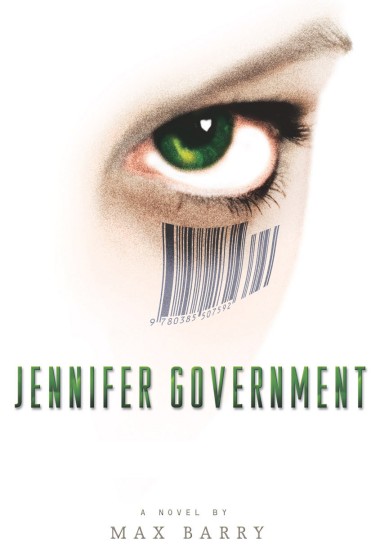
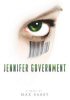
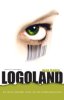
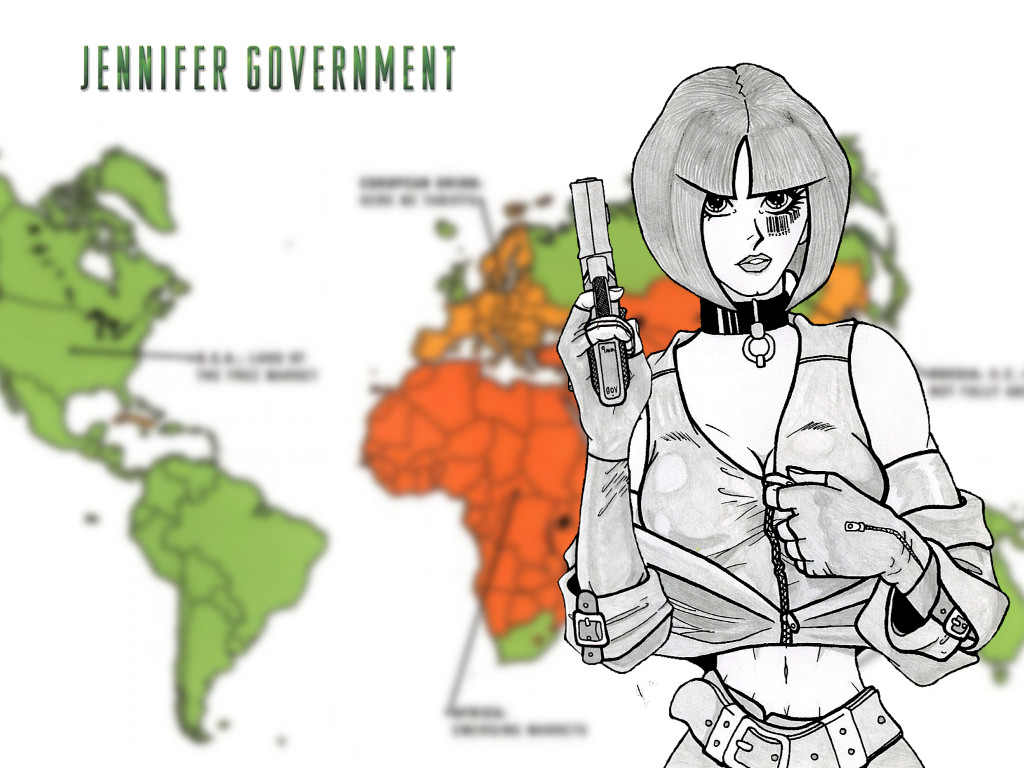
In the meantime, here’s something almost as good: a wallpaper! I stumbled across this a year ago but it took that long to track down the original artist: it started as a sketch by Patrick Shettlesworth that had nothing to do with Jennifer Government until lordkelvos of deviantART reworked it and added a barcode tattoo, which I stuck in front of a background designed by Michael J. Windsor. That’s three different people who can now sue me for copyright infringement. But at least two of them said it was okay so here you go:

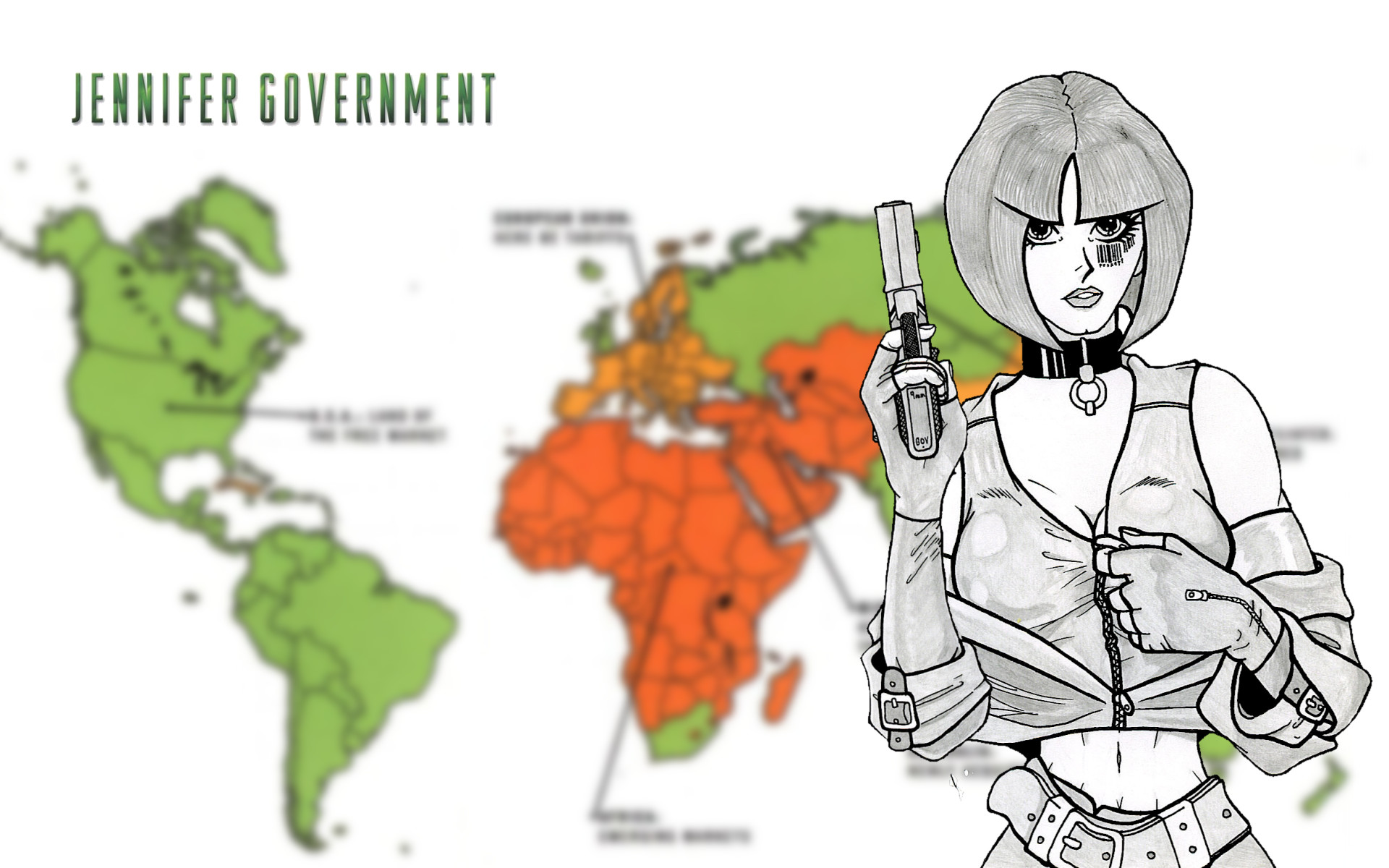
It may help you enjoy this image if you imagine you’re a teenage boy. I don’t need to do that. But you might. Here it is in different sizes: 1920x1200 (widescreen), 1280x800 (widescreen), 1440x900 (widescreen), 1600x1200, 1024x768.
The shampoo industry really needs to find a cure for baldness.
Got a cold. Spamming vitamins.
At the End of the Tunnel is an Extremely Ornate Light
I have a bunch of blogs backed up. Wait. That sounds disgusting.
Pretend I didn’t say that. What I mean is: I keep thinking of things
I want to blog about, but before I do I get distracted by emails or
real writing or my wife getting pregnant. I know. You could argue
that I have prioritization issues. On the other hand, you could argue
I don’t. It’s not like anyone pays me for these. I only do them for
the look on your face. That’s right. I’m watching you. I’m watching
you right now. See that webcam? Give me a little wave. Hello,
my pretty. Hello.
But that’s beside the point. The point is: my wife is pregnant. I can’t believe you didn’t react more when I mentioned that a second ago. You barely frowned. Oh, wait. I see. You were wondering if you already knew about that. I guess I didn’t really telegraph it. I just kind of slipped it in there. But enough about the conception. Ha ha! Joke. We used IVF. Not because we have to. We just like to employ advanced medical technology wherever possible. It’s expensive, but we think it’s worth it. They say you can’t genetically engineer your embryos, but once you get inside and they close the door, you totally can. We went for a female green-eyed redhead with a propensity to sneeze in sunlight and a tail like a fish.
Last Friday we went along for our 20-week scan. We decided to find out the sex this time, because Jen wanted to find out the sex and I couldn’t stand the idea of her knowing something I didn’t. It would have thrown off the delicate power balance of the whole relationship. You might think that’s silly but that’s what they said about Palestine. I don’t want a repeat of that. Not in my house. So off we went, and Dr. Andrew showed us that we’re having a girl! He showed us in a way that would be truly mortifying if the girl was aware of it, by the way. I kind of feel sorry for girls today growing up with DVDs of their prenatal scans tucked away in their parents’ bedside tables. You just know they’re going to come out at the 21st party. Anyway, there it is: we will have two girls, and the new one will own nothing new until she leaves home.
Before Finlay was born, her placeholder name was “Popsicle” (Poppy for short), because she was brewed from a frozen embryo. As we were walking out of the clinic, Finlay said, “We should call her Chandelier.” I don’t know where that came from. But that’s the placeholder. Chandelier Barry. A new light in the world.
Something I apparently should not be posting about until Jen has had a chance to talk to all her friends.
Something moving.
Yep. There's definitely something in there.
Today I find out something important.
"Kick Ass:" thumbs up. Of course I am a sucker for a Daddy-daughter crimefighting duo.
My cat has the ability to teleport to the location of any closing door and run through it.
Are Ginger Nut Snaps psychotropic? Because I just ate half a pack and l am SO HAPPY.
Heading to Melbourne Uni to lecture publishing students. Tweed jacket: too much?
I have become a Facebook fan of myself. That sucking noise you hear is my head disappearing up my buttocks.
Thanks for the votes! "There Isn't Even Anything" leads "Exceptions" 36 to 12.
My Stupid Industry
Lately the publishing industry has been trying to commit suicide over
electronic rights. It’s funny because every time in history a
revolutionary new way to do business comes along, the first instinct of
all established players is to strangle themselves
with it. Movie studios fought the VCR. Microsoft fought the Internet.
The music industry fought MP3s. TV networks are fighting PVRs.
Eventually, these turn into important markets, fully embraced by the
companies that tried to kill them. But until then everyone spends a lot
of time throwing lawyers at anything that doesn’t
look like a traditional business model.
The first e-madness was DRM, of course. That’s the code they wrapped around electronic books to ensure they couldn’t be pirated. Well. “Ensure” is a big word. I’m not sure that any piece of DRM in history has survived an interested hacker. What it did ensure was a steady trickle of emails to my inbox from people who couldn’t find an electronic copy of Jennifer Government in the right format for their device, or could but after they paid their money it didn’t work.
Next came e-delays, where publishers held back electronic versions for four months following print publication. “The right place for the e-book is after the hardcover but before the paperback,” said Simon & Schuster CEO Carolyn Reidy. This is a brave counterpoint to the more common wisdom that the right place for selling something is wherever customers want to buy it. So we were not just restricting e-books to particular formats within particular territories, but also to particular windows of time.
But that wasn’t enough. Publishers didn’t like the fact that Amazon.com started selling e-books for $9.99 each. (They thought that was too cheap, if you’re wondering.) It didn’t affect publishers’ margins, nor authors’ royalties, since Amazon.com was selling below cost to promote its Kindle platform. But still, publishers were uncomfortable with the idea of books being that cheap. So they went to war and forced Amazon.com to bump up prices to $13-$15, in exchange for taking a lower royalty on each sale.
Let’s review. Amazon.com was eating it in order to allow you to buy books for ten bucks, instead of twenty or thirty, while paying authors the same royalty. Publisher intervenes, and now books are more expensive for you, while the author gets less. Also, the publisher gets less. Oh, and I didn’t mention this, but during the war, Amazon.com took down all the “Buy” buttons for Macmillan books, so you definitely couldn’t buy them no matter how much you wanted to and nobody made any money at all.
I won’t say it’s impossible for an industry to push retail prices up while pushing their own margins down and be successful. I’ll just say that’s not the way it usually works. Also, as a general rule, when customers want to buy a product, it usually works out best if the company lets them. I don’t think there have been too many examples of companies making money while refusing to sell their products in the formats their customers want while also forcing retailers to charge more and pocketing less themselves. I’m not sure. But that’s my feeling.
Meanwhile, rocked by the Global Calamitous Money Disappearing Event, publishers began cutting back what they do. Ten years ago, a publisher gave hopeful authors editorial advice, a printing service, a promotional budget, and access to bricks and mortar bookstores. There was really no viable alternative, short of becoming a small publisher yourself. To become a successful author, you needed a publisher.
Today, the promotional budget is more likely to involve encouragement to do something on the internet rather than a book tour. Publishers are still fantastic at getting you into bookstores, and physical books still comprise the vast majority of the market: you need them for this. But in e-books, you can click “Export to EPUB” as easily as they can, and without giving up 75% of revenue.
Also, publishers are getting less willing to make risky bets. Instead of taking an unknown author and striving to find her an audience, they want authors to establish their own audience in advance, via a website or similar.
Now, publishing is full of terrific, smart people who love books and want to promote authors. I haven’t met a single person in publishing I didn’t like. I even love my old Viking editor, who dumped me via relayed e-mail message. I forgive you, Carolyn. I really do. But the people in charge there are trying to sue the VCR. If publishing gets tomorrow everything it wants today, it will be smaller and less relevant. Imagine the world in in ten years, when e-books are 50% of the market: What will publishers offer authors? Not the ability to find an audience, if they’re pushing that onto authors. Not the distribution network: anyone can get their book into an electronic store. Not promotion; or at least, not much of it. That leaves editorial and distribution of hard copy. Not to be sneezed at, for sure. Editorial in particular is often the difference between a great book and a mediocre one; I can attest to that. But if I’ve got a web site and a hundred thousand visitors, I’d think seriously about whether editorial and print is worth giving up 90% of my income. I would, at the least, drive a harder bargain with a publisher than if they were providing more services I really needed.
The publishing industry is trying to think long-term, like every industry that faced a revolutionary change before it. But please, this time, can we not batter ourselves to death? It’s not that complicated, Publishing. I write stories. I want people to read them. I want as many people to read them in whatever format they want, wherever they want, as cheaply as possible, while I earn a living. I don’t want lower royalties in exchange for higher retail prices. That’s the opposite of what I want. I don’t want to get emails from people saying they wanted to buy my e-book but they couldn’t because it wasn’t available or didn’t work. This is text. It’s not hard to put text on an electronic device. It’s only hard because you make it.