















Fifteen Ways to Write a Novel
 Every year I get asked what I think about
NaNoWriMo, and I don’t
know how to answer, because I don’t want to say, “I think it makes
you write a bad novel.”
Every year I get asked what I think about
NaNoWriMo, and I don’t
know how to answer, because I don’t want to say, “I think it makes
you write a bad novel.”
This is kind of the point. You’re supposed to churn out 50,000 words in one month, and by the end you have a goddamn novel, one you wouldn’t have otherwise. If it’s not Shakespeare, it’s still a goddamn novel. The NaNoWriMo FAQ says: “Aiming low is the best way to succeed,” where “succeed” means “write a goddamn novel.”
I find it hard to write a goddamn novel. I can do it, but it’s not very fun. The end product is not much fun to read, either. I have different techniques. I thought I should wait until the end of November, when a few alternatives might be of interest to those people who, like me, found it really hard to write a goddamn novel, and those people who found it worked for them could happily ignore me.
Some of these methods I use a lot, some only when I’m stuck. Some I never use, but maybe they’ll work for you. If there were a single method of writing great books, we’d all be doing it.
The Word Target
What: You don’t let yourself leave the keyboard each day until you’ve hit 2,000 words.
Why: It gets you started. You stop fretting over whether your words are perfect, which you shouldn’t be doing in a first draft. It captures your initial burst of creative energy. It gets you to the end of a first draft in only two or three months. If you can consistently hit your daily target, you feel awesome and motivated.
Why Not: It can leave you too exhausted to spend any non-writing time thinking about your story. It encourages you to pounce on adequate ideas rather than give them time to turn into great ones. It encourages you to use many words instead of few. If you take a wrong turn, you can go a long way before you realize it. It can make you feel like a failure as a writer when the problem is that you’re trying to animate a corpse. It can make you dread writing.
The Word Ceiling
What: You write no more than 500 words per day.
Why: You force yourself to finish before you really want to, which makes you spend the rest of the day thinking about getting back to the story, which often produces good new ideas. You feel good about yourself even if you only produced a few hundred words that day. You don’t beat yourself up about one or two bad writing days. You give yourself time to turn good ideas into great ones. Writing feels less like hard work. (More on this.)
Why Not: It takes longer (six months or more). It can be difficult to work on the same idea for a very long time. It may take so long that you give up.
The Coffee Shop
What: You take your laptop, order a coffee, and compose your masterpiece in public.
Why: It gets you out of the house, which may help to break a funk. You’re less likely to goof off if people are watching. It feels kind of cool.
Why Not: It’s extremely distracting. You look like a dick. You lose a deceptively large amount of time to non-writing activities (getting there, setting up, ordering coffees, considering bagels…).
The Quiet Place
What: You go to your own particular writing place and close the door on the world.
Why: It removes distractions. It can feel like a special, magical retreat, where you compose great fictions (particularly if it’s somewhere you only use for writing, not checking email, doing your taxes, and leveling your Warlock).
Why Not: You may not have one. You may find it depressing if you’ve had a tough time writing lately. You can end up fussing over making your Writing Place perfect instead of writing.
The Burst
What: You write in patches of 30-60 minutes. When you feel your concentration flag, you go do something else for 30 minutes, then return.
Why: It freshens you up. You find solutions to difficult story problems pop into your head after a breather. You can find time to write more easily, knowing you’re only sitting down for a short while. When you’re “running out of time,” you can feel energized and write very quickly.
Why Not: It’s more difficult to sink into the zone if you know another activity is just around the corner. It can encourage you to look for excuses to stop writing. It discourages more thoughtful writing.
The Immersion
What: You pull out the network cord, turn off the phone, and write in blocks of four hours.
Why: It eliminates distractions. You can relax knowing that you have plenty of time to write. It encourages thoughtful writing.
Why Not: You can wind up grinding. You can feel reluctant to start writing, knowing that such a huge block of time awaits.
The Intoxicant
What: You consume alcohol, narcotic, or caffeine before writing.
Why: Dude, those words just gush.
Why Not: You may be part of the 99.9% of the population that writes self-indulgent gibberish.
Sidenote: There is no case of writer’s block that can’t be cured with enough caffeine.
The Headphones
What: You strap on headphones and crank up the volume.
Why: It’s inspiring. It can quickly put you in the right frame of mind for a scene. It can block out other noise that would otherwise be distracting.
Why Not: You can’t think as clearly. You can be misled into thinking you’re writing a powerful/exciting/tragic scene when in fact it’s just the music.
The Break of Dawn
What: You wake, walk directly to your computer, and write.
Why: Your mind is at its clearest and most creative. You haven’t started thinking about the real world yet. Your body is not fuzzing your mind with digestion. If you write for a while, you develop a hunger dizziness that’s mildly stimulating. (This can be combined with coffee.)
Why Not: You may not be a morning person. You may only be able to write for a short while before becoming too hungry to continue. Your lifestyle may not permit it.
The Dead of Night
What: You write at night, after everyone’s gone to sleep.
Why: It feels kind of cool. It’s often a reliable distraction-free time. You can often be in a fairly clear, creative frame of mind.
Why Not: You may only be able to write for a short while before becoming too tired to write coherently. You may be too tired to repeat the process regularly. You may not be a night person.
The Jigsaw
What: You start writing the scenes (or pieces of scenes) that interest you the most, and don’t worry about connecting them until later.
Why: You capture the initial energy of ideas. You can avoid becoming derailed by detail. You make sure your novel revolves around your big ideas.
Why Not: It can be difficult to figure out how to connect the scenes after the fact. You need to rewrite heavily in order to incorporate ideas you had later for earlier sections. Your characters can be shakier because you wrote scenes for them before you knew the journey they’d make to get there.
The End-to-End
What: You start at the beginning and write the entire thing in sequence.
Why: You see the story as a reader will. You feel more confident about your characterizations, pacing, and logical progression of plot. It’s simpler.
Why Not: You can become bogged down in boring sections you think are necessary to set-up good stuff (not realizing yet that you don’t need those boring sections, or that they can be far shorter than you think). You can wind up far from where you intended to go, never finding a place for those initial ideas. (This may not be a bad thing.)
The Outline
What: You sketch out plot, characters, and turning points before you start writing.
Why: You feel like you know what you’re doing. You can feel excited because you know big stuff is coming. You tend to produce a better structure, with larger character arcs and clearer plot twists.
Why Not: What seems like a brilliant idea for an ending on day 1 can seem trite on day 150, when you understand the characters and story better. You feel pressure to make your characters do implausible things in order to fit your outline. You can close yourself off to better ideas. You can become bored because you already know what’s going to happen.
The Journey
What: You start writing with no real idea of where you’ll wind up.
Why: It’s exciting. Discovering a story as you write it is one of life’s great joys. Your characters have freedom to act more naturally and drive the story, rather than be bumped around by plot.
Why Not: You can end up nowhere very interesting. You tend to write smaller, more realistic stories, which may not be what you want.
The Restart
What: You abandon the story you’re working on, even though you know it’s brilliant and the idea is perfect but GODDAMN it is driving you insane for some reason
Why: It’s a bad idea. There might be a good idea inside it somewhere, but you’ve surrounded it with bad characters or plot or setting or something and the only way to salvage it is to let all that other stuff go.
Why Not: While loss of motivation is always, always, always because the story isn’t good enough, and some part of you knows it, you rarely need to throw away the whole thing. Often deleting the last sentence, paragraph, or scene is enough to spark ideas about new directions. Sometimes you only need to give up a plan for the future. Changing your mind about where you’re going can allow you to write the story you really want. (More on this.)
Famous Friend
Some people think it must be cool to have a famous friend. You’re
imagining hanging with someone like, say, Keanu, and Keanu
telling you things he doesn’t tell anyone else, and you ragging on him
for sucking at PlayStation. That would be cool. But what it’s
actually like is one of your friends—your real friends, say your best
friend—and he’s exactly the same only everyone thinks he’s wonderful.
Do you see how annoying that is? Because, sure, he’s
a good guy, but he’s not perfect. He’s not God. But now everyone
fawns over him and tells you how lucky you are to know him. That’s
why they pay attention to you: because you might help them get closer
to him. And
whenever you spend time with him, just the two of you, you both know he could
be somewhere else, listening to people flatter him or take him cool
places for free or sleep with him, because he’s famous.
Being friends with a famous person is the worst. And that’s why when
the magazines come sniffing around, asking just off the record,
just for background, is he really happy, and does he drink or ever do
drugs, and did he really hit that girl, you tell them everything.
Ayn Rand and a Hint
 The
New Yorker
published
one of my short stories
in full without even asking. That’s
a gross copyright violation. I’m thinking of suing. Admittedly, the story is
only 25 words long. But still. They broke the ten percent rule. Two and a half words would
have been okay. “She walks i.” I’d have no problem with that.
The
New Yorker
published
one of my short stories
in full without even asking. That’s
a gross copyright violation. I’m thinking of suing. Admittedly, the story is
only 25 words long. But still. They broke the ten percent rule. Two and a half words would
have been okay. “She walks i.” I’d have no problem with that.
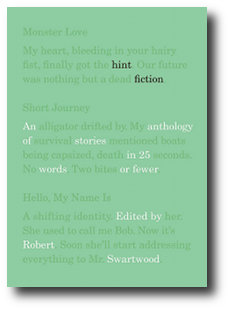
So now The New Yorker has stolen my livelihood, there’s no reason for you to buy the book it’s published in, Hint Fiction. Unless you would like to read 150 or so stories by the other contributors. I guess that’s a good reason. The deal is they are all hints: 25 words or fewer, not self-contained stories but rather suggestions of larger tales. There are some more examples, by which I mean copyright violations, in The New Yorker article, and you can pick up the book, published today in the US & Canada, here or here.
If you are in Australia, I’m on TV tonight, talking about Ayn Rand’s Atlas Shrugged. Actually, I’m doing that no matter where you are. You can’t affect it. I’m also discussing Freedom by Jonathan Franzen. I mention the Rand book first because it’s the one people will send me emails about.
Here’s the thing with Atlas Shrugged. It’s eleven hundred pages of brilliant, beautiful, go-getter industrialists talking to stupid, grasping, corrupt collectivists, set in a world where only half the laws of economics apply. The character names change but nothing else. Otherwise, it’s not bad. No, I lie. Even setting that aside, it’s terrible. I felt like Ayn Rand cornered me at a party, and three minutes in I found my first objection to what she was saying, but she kept talking without interruption for ten more days.
It’s not a novel so much as a manifesto, and, I think, impossible to enjoy unless you’re at least a little on board for the philosophy, and it’s hard to be on board for the philosophy if you understand economics or see a moral problem with starving poor people. I realize many believe fervently in the philosophy. They email me. And I don’t think it’s one hundred percent bogus. But it demands that you choose between no government or total government, and I think all such extremes have similarly extreme problems.
Freedom is good, though.
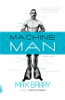
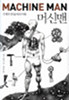
Darren Aronofsky to Direct Machine Man
 You know how I feel about film deals. At first, sure, everyone’s excited.
It’s going to be the greatest movie ever made. You’ll be walking down
the red carpet in no time, Max. You’ll be doing blow off the naked backs
of strung-out starlets. But a few years later, and you know what? No
starlets. Not one.
You know how I feel about film deals. At first, sure, everyone’s excited.
It’s going to be the greatest movie ever made. You’ll be walking down
the red carpet in no time, Max. You’ll be doing blow off the naked backs
of strung-out starlets. But a few years later, and you know what? No
starlets. Not one.
Not that it’s all about the starlets. I’m happily married. I’m just saying, it would be nice to be offered starlets. The point is, I have discovered that there’s a lot that can derail a project between sign-on and starlets. In fact, starlets seem to be the exception. Most of the time, the movie never happens.
So when the Machine Man deal happened, I tried to steel myself. “Meh,” I told people. “Not as glamorous as it sounds. Probably never go anywhere.” A few months ago, I heard Darren Aronofsky was interested in directing. “Yeah, there’s always a big name who’s interested,” I said. “Everyone’s always interested.” Then he signed on. And today it’s public, being reported in Hollywood Reporter and Variety.
Now, Aronofsky is possibly the greatest director in the world. By which I mean, if you wrote a book or a screenplay, and you wanted someone to make it into a film, you would choose him. Because many people can do smart and unsettling and entertaining, but not usually all at once.
His newest film is “Black Swan,” which premieres in the US on December 3. It’s written by Mark Heyman, who is also on board for Machine Man. So I’m basically hoping Black Swan is the best movie of all time.
It is getting harder to stay cool about this.
By the way, Aronofsky was involved with the Robocop remake before the studio imploded. So do you think he walked away with a head full of unrealized ideas about bioaugmentation or what?
Chandelier, Illuminated


My baby SUCKS. Really well. That’s important. It took her a few days to get the hang of it. But now: awesome at sucking. I’m so proud of her.
It started like this: at 2am Tuesday Jen woke me to say her waters had broken. I was confused, because we were scheduled for a Caesarean delivery at 9am, had Jen forgotten? She wasn’t supposed to labor. This must be some kind of miscommunication. But no. The baby was coming. She’d heard she was to be born today and decided to take charge.
Off to the hospital we went. Fifty-two minutes before the time we had booked four months ago, she arrived: Matilda Margrett Barry, weighing 8lb 11oz, dazzling onlookers with her rich thatch of red hair.
The smell. The smell! I had forgotten how good this was. She smells like distilled contentment.
Matilda is strong and likes to have her hands near her face. Because of this, sometimes she facepalms. I have to get a photo of that and release it on the internet. She had a restless first few days, but now the sucking is under control, has been happy and very snuggly. She snuffles and snorts. Her big sister Finlay, who turned five yesterday by the way, can you believe that? Her big sister is super-super excited. Look at that smile. There’s ownership.
Today we arrived home. It’s been a great day. I wish you all this kind of happiness.
P.S. I once wrote a blog about how before I named my next child, I would make sure the domain name was available. Well, I completely forgot about this until Day 3 in the hospital, long after tweeting her arrival. The five panicked minutes between realizing this and securing matildabarry.com were the most nerve-wracking part of the entire experience.
Max! Does! Stuff!
Here is a short story!
Not by me. Oh. Sorry. You thought… you’re
right, that was confusing. No, this is by Sean Silleck.
He’s nobody. I say that with the deepest respect. I mean he’s only
had one thing published and this is it. But check it out: it’s like
something I would write, if I was having a really good day.
I mean, eerily so. It’s like the guy is hanging around my house after
dark, going through my trash. I’m not saying he is. I’m not saying
anything until the police have finished their investigation. But really.
Eerie.
I swapped a few emails with Sean and it turns out he’s never heard of me in his life. That was kind of disappointing. I was all excited that I had inspired a bright young talent. But no. Apparently I’m just working with ideas so obvious that anyone can have them.
Speaking of shorts, I’m judging a short story contest! You can win $1,500 just by writing the kind of thing you already know I like. It’s practically rigged in your favor. Although you do have to be Australian. I suppose that’s the catch.
If you’re not Australian, I still have something for you. Wait. No, this is local, too. Wow. This blog is just getting more and more pointless for you. But anyway, I’m rocking out the Wheeler Centre in Melbourne next week with the Writer’s Mix Tape. The idea is I bring along a CD of significant/pumping tunes and play them and talk about why what they mean and finish with an awesome breakdance. It’s something like that. I’m there with Rob Jan of RRR radio. You should be, too. Unless you live thousands of miles away. In which case I’m very sorry for wasting your time. As you were.
Walkabout
I shaved my head totally bald and the skin is so baby-smooth I can’t
stop touching it. That’s not relevant to anything. I don’t know why I
brought it up. But seriously. Baby-smooth.
So I didn’t blog or go on Facebook or Twitter for six weeks and you know what? It was kind of good. It was like walking into the desert and rediscovering Nature. It was like being born again. It was like looking at a photo of who I used to be.
No, not really. It was pretty much like this, only I had more free time and hadn’t heard of Zach Anner.
I have been doing lots of writing. The last big Machine Man novel rewrite is almost finished, and I started something new. I was planning another serial, but this kind of grabbed me and it’s not at all serial-like. So now I’m not sure about serials. I’ll see where I am in three months.
Anyway, I just wanted to let you know I’m here and writing and I know who Zach Anner is. Also: baby-smooth.
 15 comments
| MaxBarry.com ›
Max ›
Walkabout
15 comments
| MaxBarry.com ›
Max ›
Walkabout
Mind of the Agent
I remember when I was desperate to find a girl but had no idea what
they wanted. I knew what I wanted. I wanted them to take delivery
of my package. But how to convince them? What did they want from me?
Where could I find one with a good reputation, who didn’t charge
fees?
Wait, did I say girl? I meant literary agent. I couldn’t find a literary agent.
Now there are tons of sites about literary agents. Some are by agents. My favorite is Nathan Bransford of Curtis Brown, but there are plenty to choose from. There’s no longer any excuse for not knowing at least a little about how an agent’s mind works: what they’re looking for, how to approach them.
Still, the other day I received an email from a writer facing a quandary:
A Literary Agent has given me a favourable reply (ie: wants to see my entire manuscript from a lousy query letter), so I immediately panicked and sent it to a “professional editing” service (one listed on Australian Literary Agents Website) for a final Mr Sheening. Do Literary Agents have a time limit before they get miffed if you don’t send manuscript by return email? The Editing Service assures me that I have two months (?) to submit, as they have not started it yet, but “it is on the top of their pile”.
Help… please?
Yours in awe
Elle
Usually I can’t respond to emails, but I make an exception for those that sign off, “Yours in awe.” So I replied, and then I thought I might as well post my response here, because it was just that good. Or possibly not, but what the hell, it’s not like I’m forcing you to keep reading.
Hi Elle!
This is why you don’t query agents until your book is ready, of course. But I know it happens. I queried a few agents with my first novel then freaked out because what if they wanted to see it? I think I did lightning rewrites every time someone responded.
I see two issues. The first is: Are you damaging your chances if you don’t respond to an agent immediately? If we were talking about American agents, I’d say, “Maybe.” Most reputable American agents receive more queries than they can remember, and might not notice whether it’s been two weeks or two months since they asked to see yours. But they might.
For an Australian agent I’d say, “Probably.” They deal with far fewer writers and are more likely to wonder what’s going on.
But either way, I’d send them that manuscript. Agents want reliable clients, and if the first thing you do is delay, they’ll worry you are one of those writers who are forever six months away from finishing their next book. For this reason you should not reply with some pathetic story about how you thought your book was ready but now you think about it can you please have a few more months. Don’t do that.
You are worried that your book could be better; well, it probably could. They all could. Do you think yours has little flaws or big ones? If they’re minor, they’re unlikely to dissuade an editor who otherwise loves your work, and if they’re major, you’re dead no matter what: dead if you send in that piece of crap, dead if you wait for two months only to discover from this editing service that you need to spend six more on rewrites.
Speaking of which. There are very fine freelance editors out there but I don’t like the concept. In particular I think it’s bad for amateur writers with no idea what’s good and bad about their book to consult a freelance editor in the hope that this expert can explain it. It’s bad because (a) to rewrite well you need to completely believe in what you’re doing. Receiving advice you don’t really understand or agree with but feel compelled to follow anyway because it’s coming from an expert will crush everything unique and valuable about your book.
And (b) some freelance editors are delusional psychopaths.
By my reckoning, about one in four pieces of literary feedback are so wide of the mark they’re not just unhelpful but destructive. They want your book to be more like a completely different type of book, or prostrate itself before the altar of Strunk & White, or not imply things about hot-button issues you never even thought of, or go into depth about things nobody cares about, or not do this mildly felonious thing that someone tore strips off them for at their last story workshop, or stop reminding them of their ex-wife.
I’m talking about feedback from other writers and readers, rather than editors; you would hope freelance editors are less delusional than writers. But I don’t know. Why take the risk? This is why I advocate quantity: get your ms. read by at least eight or ten people before you show it to anyone in the industry. Enough to identify the outliers.
Obviously I haven’t read your manuscript (that wasn’t an invitation). I don’t know which editing service you’ve selected, or how experienced you are, or whether you’ve workshopped it already. But based on what I know: send it. You’re more likely to hurt yourself by not sending it than you are to help yourself by delaying for months in order to maybe improve it but maybe not.
Good luck!
Max.
If you blink really fast it kind of moves
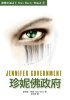
 Who do I have to hug to get a Jennifer Government movie made,
that’s what I want to know. It’s been like seven years. Yeah, yeah, it’s hard to
make a story work in 100 minutes when you’ve got six major characters and
nine interconnected plots. Boo hoo. You know what that sounds like? “I’m a crappy
screenwriter.”
Who do I have to hug to get a Jennifer Government movie made,
that’s what I want to know. It’s been like seven years. Yeah, yeah, it’s hard to
make a story work in 100 minutes when you’ve got six major characters and
nine interconnected plots. Boo hoo. You know what that sounds like? “I’m a crappy
screenwriter.”
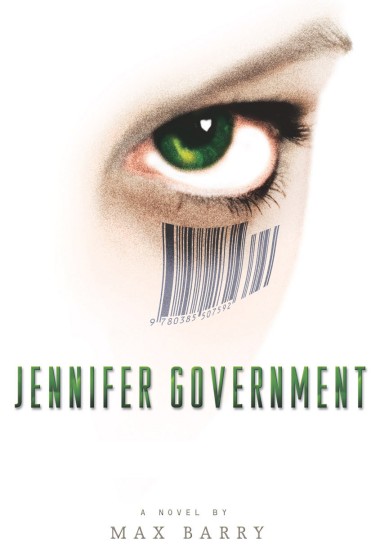
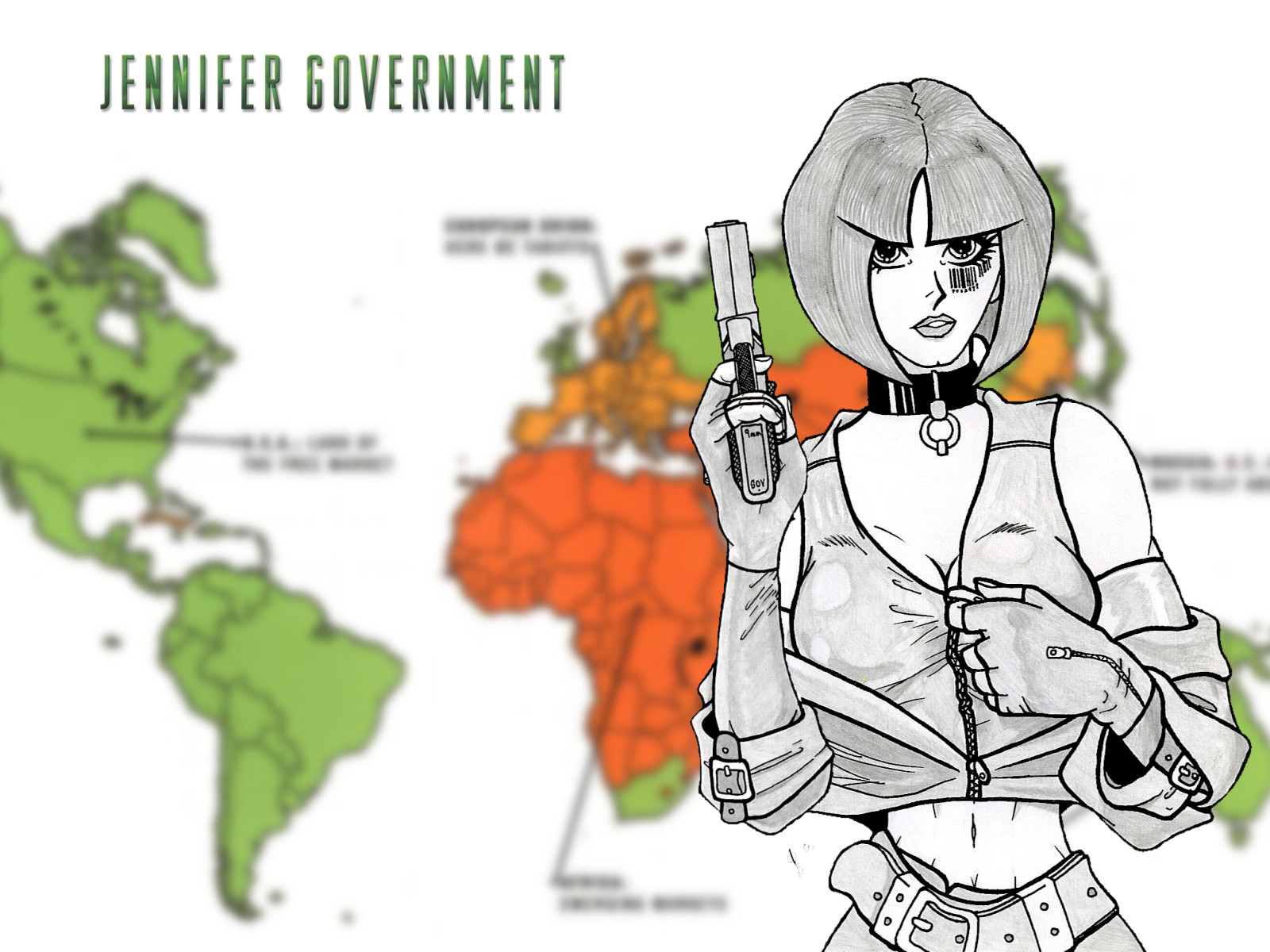
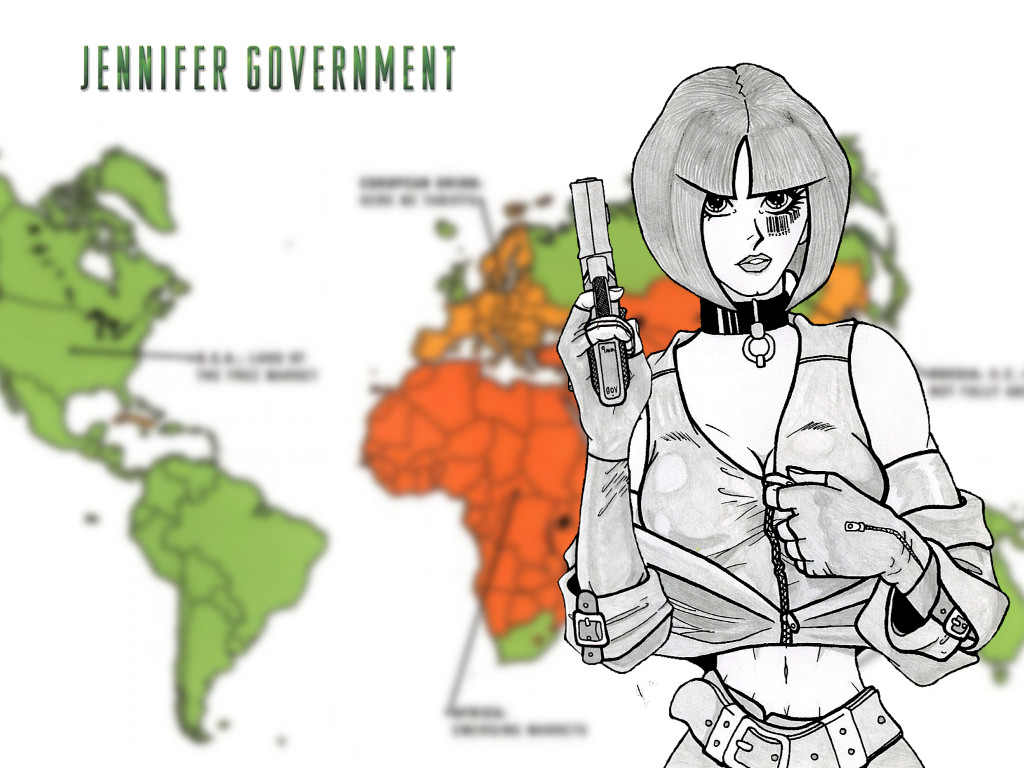
In the meantime, here’s something almost as good: a wallpaper! I stumbled across this a year ago but it took that long to track down the original artist: it started as a sketch by Patrick Shettlesworth that had nothing to do with Jennifer Government until lordkelvos of deviantART reworked it and added a barcode tattoo, which I stuck in front of a background designed by Michael J. Windsor. That’s three different people who can now sue me for copyright infringement. But at least two of them said it was okay so here you go:

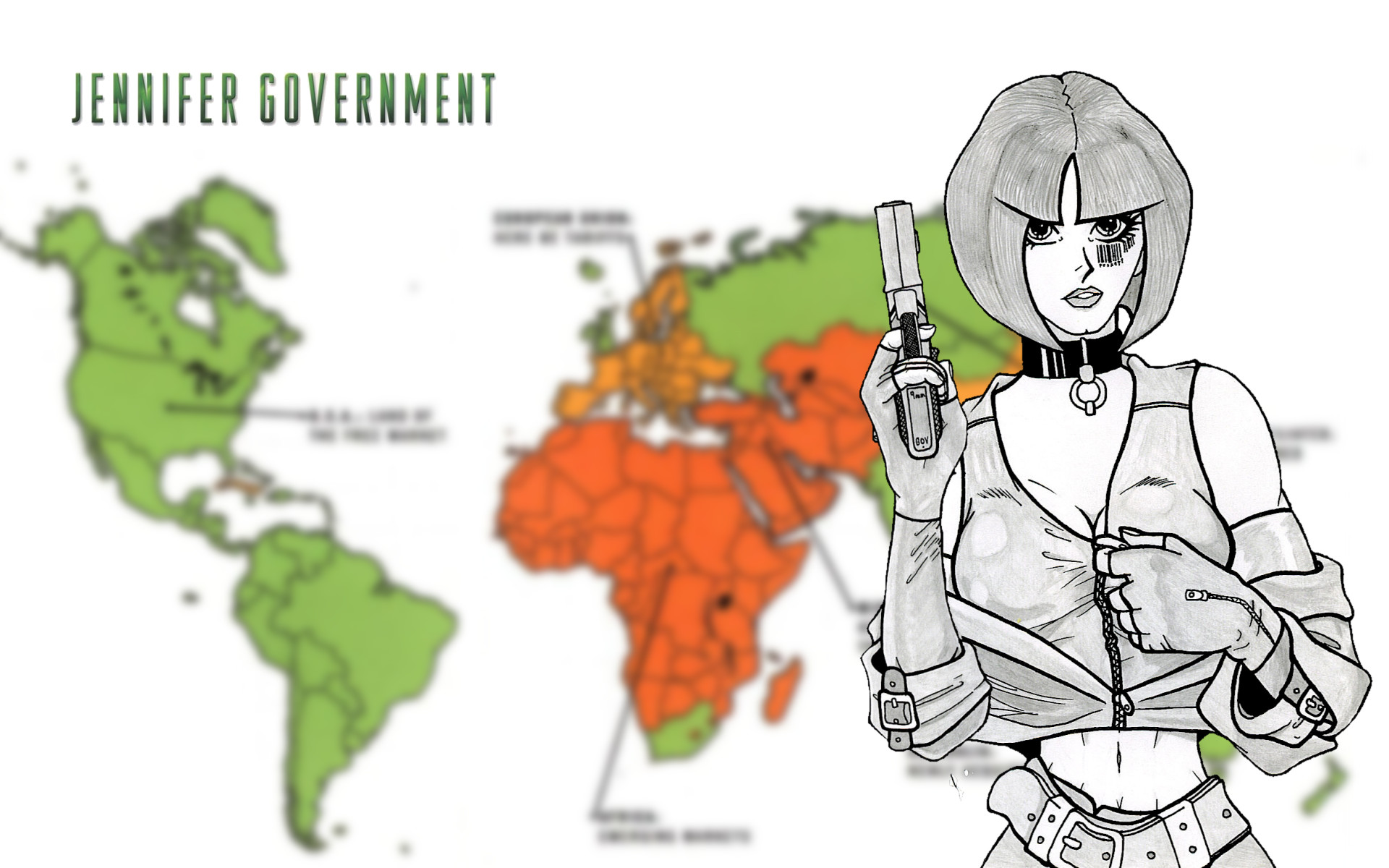
It may help you enjoy this image if you imagine you’re a teenage boy. I don’t need to do that. But you might. Here it is in different sizes: 1920x1200 (widescreen), 1280x800 (widescreen), 1440x900 (widescreen), 1600x1200, 1024x768.
At the End of the Tunnel is an Extremely Ornate Light
I have a bunch of blogs backed up. Wait. That sounds disgusting.
Pretend I didn’t say that. What I mean is: I keep thinking of things
I want to blog about, but before I do I get distracted by emails or
real writing or my wife getting pregnant. I know. You could argue
that I have prioritization issues. On the other hand, you could argue
I don’t. It’s not like anyone pays me for these. I only do them for
the look on your face. That’s right. I’m watching you. I’m watching
you right now. See that webcam? Give me a little wave. Hello,
my pretty. Hello.
But that’s beside the point. The point is: my wife is pregnant. I can’t believe you didn’t react more when I mentioned that a second ago. You barely frowned. Oh, wait. I see. You were wondering if you already knew about that. I guess I didn’t really telegraph it. I just kind of slipped it in there. But enough about the conception. Ha ha! Joke. We used IVF. Not because we have to. We just like to employ advanced medical technology wherever possible. It’s expensive, but we think it’s worth it. They say you can’t genetically engineer your embryos, but once you get inside and they close the door, you totally can. We went for a female green-eyed redhead with a propensity to sneeze in sunlight and a tail like a fish.
Last Friday we went along for our 20-week scan. We decided to find out the sex this time, because Jen wanted to find out the sex and I couldn’t stand the idea of her knowing something I didn’t. It would have thrown off the delicate power balance of the whole relationship. You might think that’s silly but that’s what they said about Palestine. I don’t want a repeat of that. Not in my house. So off we went, and Dr. Andrew showed us that we’re having a girl! He showed us in a way that would be truly mortifying if the girl was aware of it, by the way. I kind of feel sorry for girls today growing up with DVDs of their prenatal scans tucked away in their parents’ bedside tables. You just know they’re going to come out at the 21st party. Anyway, there it is: we will have two girls, and the new one will own nothing new until she leaves home.
Before Finlay was born, her placeholder name was “Popsicle” (Poppy for short), because she was brewed from a frozen embryo. As we were walking out of the clinic, Finlay said, “We should call her Chandelier.” I don’t know where that came from. But that’s the placeholder. Chandelier Barry. A new light in the world.
My Stupid Industry
Lately the publishing industry has been trying to commit suicide over
electronic rights. It’s funny because every time in history a
revolutionary new way to do business comes along, the first instinct of
all established players is to strangle themselves
with it. Movie studios fought the VCR. Microsoft fought the Internet.
The music industry fought MP3s. TV networks are fighting PVRs.
Eventually, these turn into important markets, fully embraced by the
companies that tried to kill them. But until then everyone spends a lot
of time throwing lawyers at anything that doesn’t
look like a traditional business model.
The first e-madness was DRM, of course. That’s the code they wrapped around electronic books to ensure they couldn’t be pirated. Well. “Ensure” is a big word. I’m not sure that any piece of DRM in history has survived an interested hacker. What it did ensure was a steady trickle of emails to my inbox from people who couldn’t find an electronic copy of Jennifer Government in the right format for their device, or could but after they paid their money it didn’t work.
Next came e-delays, where publishers held back electronic versions for four months following print publication. “The right place for the e-book is after the hardcover but before the paperback,” said Simon & Schuster CEO Carolyn Reidy. This is a brave counterpoint to the more common wisdom that the right place for selling something is wherever customers want to buy it. So we were not just restricting e-books to particular formats within particular territories, but also to particular windows of time.
But that wasn’t enough. Publishers didn’t like the fact that Amazon.com started selling e-books for $9.99 each. (They thought that was too cheap, if you’re wondering.) It didn’t affect publishers’ margins, nor authors’ royalties, since Amazon.com was selling below cost to promote its Kindle platform. But still, publishers were uncomfortable with the idea of books being that cheap. So they went to war and forced Amazon.com to bump up prices to $13-$15, in exchange for taking a lower royalty on each sale.
Let’s review. Amazon.com was eating it in order to allow you to buy books for ten bucks, instead of twenty or thirty, while paying authors the same royalty. Publisher intervenes, and now books are more expensive for you, while the author gets less. Also, the publisher gets less. Oh, and I didn’t mention this, but during the war, Amazon.com took down all the “Buy” buttons for Macmillan books, so you definitely couldn’t buy them no matter how much you wanted to and nobody made any money at all.
I won’t say it’s impossible for an industry to push retail prices up while pushing their own margins down and be successful. I’ll just say that’s not the way it usually works. Also, as a general rule, when customers want to buy a product, it usually works out best if the company lets them. I don’t think there have been too many examples of companies making money while refusing to sell their products in the formats their customers want while also forcing retailers to charge more and pocketing less themselves. I’m not sure. But that’s my feeling.
Meanwhile, rocked by the Global Calamitous Money Disappearing Event, publishers began cutting back what they do. Ten years ago, a publisher gave hopeful authors editorial advice, a printing service, a promotional budget, and access to bricks and mortar bookstores. There was really no viable alternative, short of becoming a small publisher yourself. To become a successful author, you needed a publisher.
Today, the promotional budget is more likely to involve encouragement to do something on the internet rather than a book tour. Publishers are still fantastic at getting you into bookstores, and physical books still comprise the vast majority of the market: you need them for this. But in e-books, you can click “Export to EPUB” as easily as they can, and without giving up 75% of revenue.
Also, publishers are getting less willing to make risky bets. Instead of taking an unknown author and striving to find her an audience, they want authors to establish their own audience in advance, via a website or similar.
Now, publishing is full of terrific, smart people who love books and want to promote authors. I haven’t met a single person in publishing I didn’t like. I even love my old Viking editor, who dumped me via relayed e-mail message. I forgive you, Carolyn. I really do. But the people in charge there are trying to sue the VCR. If publishing gets tomorrow everything it wants today, it will be smaller and less relevant. Imagine the world in in ten years, when e-books are 50% of the market: What will publishers offer authors? Not the ability to find an audience, if they’re pushing that onto authors. Not the distribution network: anyone can get their book into an electronic store. Not promotion; or at least, not much of it. That leaves editorial and distribution of hard copy. Not to be sneezed at, for sure. Editorial in particular is often the difference between a great book and a mediocre one; I can attest to that. But if I’ve got a web site and a hundred thousand visitors, I’d think seriously about whether editorial and print is worth giving up 90% of my income. I would, at the least, drive a harder bargain with a publisher than if they were providing more services I really needed.
The publishing industry is trying to think long-term, like every industry that faced a revolutionary change before it. But please, this time, can we not batter ourselves to death? It’s not that complicated, Publishing. I write stories. I want people to read them. I want as many people to read them in whatever format they want, wherever they want, as cheaply as possible, while I earn a living. I don’t want lower royalties in exchange for higher retail prices. That’s the opposite of what I want. I don’t want to get emails from people saying they wanted to buy my e-book but they couldn’t because it wasn’t available or didn’t work. This is text. It’s not hard to put text on an electronic device. It’s only hard because you make it.
Fiction For Short Attention Oh Look At That Laughing Dog
 Since
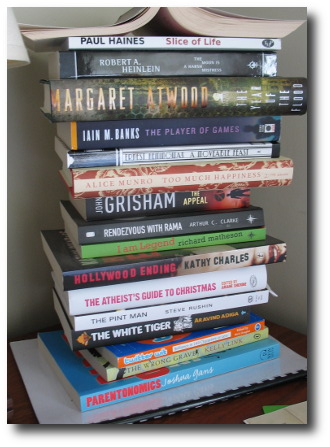
I got a iPhone, my bedside table has turned into a tower of books. It was
always pretty bad. But now it’s worse. Look at that. It’s a fire hazard. One
day I’ll toss a cigarette in there and it’ll be a conflagration. Not that I
smoke. That’s the only thing saving my life.
Since
I got a iPhone, my bedside table has turned into a tower of books. It was
always pretty bad. But now it’s worse. Look at that. It’s a fire hazard. One
day I’ll toss a cigarette in there and it’ll be a conflagration. Not that I
smoke. That’s the only thing saving my life.
The problem is when I go to bed, instead of picking up a book, I think, “I’ll just check Reddit.” Or Twitter. Or the news. Or Facebook. Or my email. Not or. And. I check all those things. I have 65 apps. I just counted. Halfway, I thought, “I wonder if there’s an app for counting your apps.” I was tempted to take 20 minutes and hunt one down, so I wouldn’t have to waste ten seconds the next time I need this information. You see what’s going on here. It’s a sickness.
It’s got me thinking I should do more short attention span fiction. Maybe another serial, like Machine Man. Firstly, because that was fun as hell, in a terrifying kind of way. Secondly, because I’m rewriting it as a novel, and it’s pretty great. I already have the story. Now I get to play around in all the spaces I skipped over because the serial had to go go go. It’s a good system.
But thirdly because maybe no-one has the time to sit down with entire novels any more. Or rather, maybe there is a class of people, to which I belong, that is becoming addicted to bite-sized information delivered by scattershot. I hope there’s a class. I hope it’s not just me.
Not that it has to be one or the other. I’m not saying that once you sign up to Facebook, you abandon Margaret Atwood. Although I have done exactly that. The Year of the Flood is just sitting there. What I mean is that the novel seems to be getting more competition. The novel is very strong, of course; there is no replacing the novel. But the competition is pretty great. The internet is everything in bite-sized pieces. It’s candy-flavored stream of consciousness of whatever you want.
And increasingly the same device will access both. I’m having trouble getting to novels just because an iPhone is in the same vicinity. What happens when my books are actually on my phone? Or in my iPad? When I’m one swipe away from the web, will I still be able to completely sink into a novel? Plenty of times I’ve slogged my way through a book that wasn’t really holding my attention just because it was there, in my hands. I don’t think I’d do that on an iPad. I think I’d tap that bastard into oblivion and answer an email.
So I am interested in fiction that works with the internet, rather than fights it. Something that doesn’t sit there, 400 pages heavy, asking for a seven-hour commitment before I start. That’s the kind of fiction I’d like to read right now. Something that sneaks under my guard and pries me away from memes and status updates. I would like to find that.
My Kid Says the Darndest Things
I have a little parenting problem. I need some advice. The other day I was out walking with Finlay (four years old; I know, I can’t believe it either) and an elderly woman stopped to coo over her. This woman was clearly someone’s grandmother. She was matronly. I’m thinking of the word “battleship.” You know what I’m getting at.
“So cute,” said the grandmother. I said thanks and Fin said nothing and the woman began to move away. Then Fin said, “She’s got big boobs.”
Into my stunned silence, Fin added, “Really big boobs.”
A few days later, out with her mother, Fin remarked about a passer-by: “She has large upper arms.”
Before that, on a train: “Look at that little person.”
We’ve tried to raise her to believe there’s nothing wrong with people who look different. That differences are interesting but not shameful. That seems to be working. It’s working a little too well. What do I do now?
I don’t want to tell her that some people are embarrassed about how they look. That starts with “are” and ends with “should be.” I can see a case for not commenting on people’s weight, because being very over- or under-weight is unhealthy, and we’ve talked about health and eating balanced meals. But I know she’s going to spend her life drowning in messages about body size, and she doesn’t need that yet. Also, it only deals with the “large upper arms” comments, not the “Look at that little person” ones.
My feeling is that while there is nothing wrong with being a three-foot-tall grownup, and it is interesting, they probably don’t want to be singled out for it all the time. But maybe this is my hangup. I wouldn’t be offended if a four-year-old pointed at me and said, “That man has no hair,” but if his mother acted embarrassed and tried to shush him, I would. Because she would be making it into a bad thing. Maybe it’s the same with everything.
But that leaves me, what? Smiling at amputees after my kid points out they have no legs? Saying, “Yes, you’re right,” when she remarks on the size of an obese man’s buttocks? This is a minefield. What do I do?
The Lawnmower People
 I was all set to do a blog about how using Windows is like growing evil tomatoes,
then American corporations became real people. They’ve been people for a while,
of course: they have the right to own things and sue you and claim they’ve been
defamed. Your chair can’t do that. A corporation can, because it’s a person.
I was all set to do a blog about how using Windows is like growing evil tomatoes,
then American corporations became real people. They’ve been people for a while,
of course: they have the right to own things and sue you and claim they’ve been
defamed. Your chair can’t do that. A corporation can, because it’s a person.
But they weren’t enough of a person, apparently, so now they have First Amendment rights. In particular, they have the right to spend as much money as they like on political advertising: airing ads in favor of anti-regulation candidates over pro-regulation ones, for example.
I find it helpful to think of corporations as lawnmowers. Lawnmowers are good at cutting grass. It’s all they want to do. They’re not very concerned about what gets in the way of cutting grass. If, for example, we discover that one of the lawnmowers sometimes kills people, the lawnmower would rather pretend there isn’t a problem than stop mowing lawns. It seems callous to us. But you have to remember, it’s not a person. It’s a lawnmower.
Corporations pursue profit; the fewer people watching, the more ruthlessly they do it. It’s not coincidence that Apple is a relatively nice corporation and Halliburton is not. It’s not that Apple was raised right while Halliburton had a distant father. It’s that Apple’s profits depend more heavily on consumer opinion. It can’t make money unless it’s likable, so it is.
I think lawnmowers are useful. I don’t want to get rid of them. But I very much want to keep them on the lawns.
The Supreme Court has let them into homes: now the lawnmowers will speak to us through TV, radio, internet, print, and tell us who to vote for. That might not seem like a problem. After all, you are a smart person. You’re probably not persuaded by advertising. The thing is, everyone thinks that, and advertising is an $600 billion industry. Someone, somewhere is getting $600 billion worth of persuasion.
It’s pretty obvious that lawnmowers will back pro-lawnmower candidates. They are functionally and legally prevented from doing anything else. In fact, now that the opportunity exists, lawnmowers are compelled to exploit it.
Honestly, I had started to think that the world of Jennifer Government was getting far-fetched. It seemed like corporations were not overpowering the government at all; instead, the two were slowly merging into a govern-corp megabeast. But this changes things. Until now, corporate lobbyists have essentially stood in opposition to voters: politicians wanted lobbyist money, but resisted giving in too much for fear of being punished at the ballot box. Now corporations can work it both ways. They can buy off the politicians and sell the voters on why that’s A-OK. They won’t have to come up with the media messages themselves. That’s a job for the ad agency. All they’ll do is write up the ad brief, spelling out what they want people to think, and sign the checks.
Supreme Court Justice John Paul Stevens, in handing down a dissenting decision, raised the prospect of corporations being given the vote. Since, after all, they are people now. We might as well. A single vote is nothing compared to what they’ll do by bringing their wealth to mass persuasive political advertising.
It’s interesting to note how corporations get to pick and choose the good parts of being a person. They can own property but can’t go to prison. They can sue you into bankruptcy, which you have to live with for the rest of your life, but if you win a big case against them, you get nothing while they reconstitute their assets and arise, Phoenix-like, under a new name. If you misbehave, you are personally responsible; a corporation jettisons a minor component it says was to blame. There is no ending them. This is the kind of personhood you would choose, if you could. It’s what happens when people making laws about corporations are themselves beholden to corporations.
It’s not evil, exactly. It’s just everyone doing their jobs. It’s just the way the system works: the system that is increasingly designed by lawnmowers.